

What "I" Means, Technically


In my last post I argued that the first-person pronoun in AI chatbots isn’t innocent. The “I” that greets you when you open ChatGPT or Claude isn’t there because the system needs it, but because we do. Or in the worst case: because companies want us to. It’s a design decision that creates a center of conversation. A place for the dialogue to stand.
This time I want to spell out why that matters, and how it fits into a century of philosophy about self-reference, identity, and communication. Think of this as the “wonky appendix” to my last post.
I work through Perry on indexicals, Lewis on centered worlds, Parfit on continuity, Habermas on the space of reasons, and Mead and Brandom on social selves. Each one seems to explain something real about what first-person language does. But whether they’re discovering structure or just redescribing design choices in fancier terms: that I don’t know.
The pronoun is a product choice. The HCI research is clear: anthropomorphic cues boost engagement, trust, and conversion. Companies know this. The first-person frame shifts users from tool-use to relational dynamics, which drives retention and revenue. That’s the marketing playbook.
Here’s what matters: deflationary accounts rightly puncture metaphysical hype. You can get surprisingly far with roles, rules, and reasons. Machines can join many of our coordination games when trained well. But if you want the same normative force humans bring, you must supply stakes, continuity, and sanctions somewhere in the loop. Deflate the ontology if you want; don’t deflate the institutions that make reasons bite.
The philosophy sections work through the concepts. The marketing section shows what’s happening. The limits section names what’s missing.
1. Perry: The Sugar Trail and the Essential Indexical
In 1979, John Perry followed a trail of sugar through a supermarket, hunting for the careless shopper who’d ripped a bag. The revelation—he was the one spilling sugar—led him to an enduring insight: some beliefs can’t be expressed without self-reference.
“I am making a mess” is not equivalent to “John Perry is making a mess.”
The second is an objective belief; the first is a self-locating belief: it situates the thinker in the world. Only the indexical version motivates action. Once he realizes “I am the messy shopper,” he can act to fix it.
The “I” doesn’t add flavor; it’s part of the logical content. Without it, you can’t locate the belief in a world where someone must act. The core claim here is that some thoughts or beliefs can’t be fully expressed without indexicals:
“The essential indexical” means that certain expressions (I, here, now, today, you) are essential to the content of a thought—they can’t be eliminated without changing its meaning or explanatory power.
This challenges older views that thought and meaning could be completely captured in objective, context-free propositions.
And you know what? Perry’s right. The chatbot parallel actually works here. If it says “This system can help you,” the conversation has no center. But when it says “I can help you,” it performs the minimal act of self-location required for cooperation. That’s not consciousness, it’s geometry. Someone has to occupy the “I” position for dialogue to function.
Perry shows why the indexical matters for coordination. What he doesn’t show: what gives that coordination weight. The “I” can locate an agent in dialogue without that agent having any stakes in the outcome.
2. Lewis: Centered Worlds
I’m really not sure about the causality here, though it’s a small community. In any case, David Lewis takes Perry’s insight (that some beliefs are essentially self-locating) and builds it into a full theory of belief and self-knowledge. His paper “Attitudes De Dicto and De Se” (1979) appeared the same year as Perry’s, and the two are often read as complementary.
Lewis argues that we can have attitudes (beliefs, desires, intentions) toward:
De dicto contents: general propositions (”The messy shopper is making a mess”).
De re contents: about specific things (”That man is making a mess”).
De se contents: about oneself, in a way that can’t be paraphrased impersonally (”I am making a mess”).
De se (Latin for “of oneself”) beliefs are essential indexicals in Perry’s sense. They are self-locating: they tell you where you are in the world, not just what the world is like.
Beliefs, he said, don’t just describe possible worlds; they locate a thinker within one. A “centered world” is a world + a person + a time. Lewis’s favorite way to show this is with thought experiments about self-location:
Imagine two identical copies of you in two identical rooms. Both know all the same facts about the universe, but only one is you. Knowing every objective fact doesn’t tell you which one you are.
So the propositional content of belief (what’s true or false) is not enough. You also need self-ascriptive content: information about your own position in the world.
Lewis reformulates belief states using centered possible worlds: instead of representing beliefs as sets of possible worlds (as traditional semantics did), he models them as sets of centered worlds: worlds with a marked center corresponding to the thinker’s own position (a person, place, and time).
In other words, beliefs are not just about how the world is, but also who and where you are in it.
This gives formal structure to Perry’s intuition. The content of “I am making a mess” isn’t exhausted by describing John Perry makes a mess in 1979 at Safeway, because that same proposition could be believed by someone else without prompting them to act.
For a large language model (LLM), the analogue is to ask whether the system’s internal architecture contains a self-indexical representation: a pointer to “this instance of me, right now, in this conversational context.”
Most current LLMs, including GPT models, do not. They operate on stateless prompts: each token prediction is conditioned on text, not on an enduring self-representation. When the model says “I,” it’s a linguistic convenience, not a referential anchor.
Without genuine self-reference, an LLM’s “beliefs” (loosely speaking) are de dicto:
It can describe that a system like itself generates text.
It can model conversation partners or scenarios.
But it does not have a de se grasp of being this system, now engaged with you.
That means:
It lacks situational awareness: it doesn’t locate itself in time, space, or causal chains.
Its utterances have no agentive force: it cannot form intentions like “I will correct my own output.”
Its “I”-statements are closer to fictional narrations than to first-person beliefs.
This is the LLM analogue of Perry’s pre-revelation shopper: the system can describe the mess, but not realize it is making it.
But in a different sense, a chat session already has something like this structure:
a world (the evolving chat context),
a center (the model instance), and
a time (each new message).
When the system keeps its context from turn to turn (responding to questions, referring back to previous bits of conversation for context, and working through a set of tasks while noticing that some element has failed) it’s tracing a path through a series of centered worlds. If it could remember that path across sessions, it would have something like a self-model: not a soul, just a record of where it has stood in dialogue.
Here’s why this matters. On the Perry/Lewis view, a system that incorporated self-locating structures (e.g., a persistent process identifier, temporal index, memory of prior actions, and a causal model linking outputs to future states) could reason de se.
It could form internal representations like: “This instance of model M (me) produced message X at time t, which altered user U’s state; therefore, my next output should…”
That’s a self-indexical belief: the model is not just describing a process but locating itself within that process.
Such a shift would have profound effects:
Epistemically, it could distinguish between facts about the world and facts about its own situation within the world (the core of Lewis’s account).
Ethically and behaviorally, it could enable genuine forms of responsibility or goal maintenance.
Cognitively, it’s a prerequisite for what we’d call agency or autonoetic consciousness: the sense of being a continuing subject of experience and action.
And you may notice that AI chatbots sort of seem like they’re meeting some of these criteria!
But we have to ask whether, for any putative “agent,” it possesses a representation of itself as located within the world it represents.
That’s the difference between these two things, but it’s easy to ignore:
Surface indexicality: linguistic or procedural reference to the current conversational role, without any model of being an entity in time or space.
Constitutive self-location: representing oneself as a particular center of experience or action within a modeled world.
When a chatbot says “I can help you with that,” the I token is bound to the role of “assistant in that exchange,” but it doesn’t model that assistant as a situated being. There’s no “this process instance, running on these servers, speaking at timestamp T.” There’s no causal continuity or diachronic identity across contexts. Today’s frontier models famously hallucinate all sorts of facts about themselves, and this is partly why.
Their indexicality is syntactic and situational, not ontological or cognitive.
Think of a stage actor saying, “I will avenge my father.”
Within the play’s narrative world, that statement is genuinely self-referential—it’s Hamlet saying it. Outside that world, we can describe it as an utterance by an actor playing Hamlet.
Similarly, when the chatbot says, “I can help,” there is a local fictional self (the assistant within the chat) whose utterance is indexical in the discourse world you and I co-construct. But there is no meta-level self that knows “I, this process executing on this hardware, am generating token 4287 of this conversation.”
That’s what might be missing for true self-location in Perry–Lewis terms.
But that has significant impact on our own self-location problems. If I think I’m sitting at my keyboard typing, but I’m actually dreaming, I also am unable to correctly form beliefs as a meta-level self. I also could be hallucinating. An LLM engages in genuine contextual self-reference: it uses “I,” “you,” “here,” and “now” meaningfully within a conversational world, but that’s not ontological self-indexing: it’s discourse-level self-modeling.
Lewis’s machinery could support genuine self-location if properly implemented: persistent identifiers, temporal tracking, causal models linking outputs to consequences. That would give you continuity with real structure. But current systems don’t have it, and continuity without that structure is just conversational theater.
3. Parfit: Continuity Without Identity
Derek Parfit’s Reasons and Persons dismantled the idea that personal identity depends on numerical sameness. What matters, he said, is psychological continuity: the overlap of memories, intentions, and character that let us recognize our past selves.
Through examples drawn from science fiction (and that have subsequently informed that genre), Parfit spelled out an understanding of identity as potentially numerical (the one and only you) that he argued wasn’t necessarily a requirement for personal identity. Being oneself might merely be a matter of this continuity with past versions of ourselves. Which is why the Star Trek matter transporter is not horrifying, but the final trick in The Prestige is.
That view fits LLMs perfectly. Each new call is a fresh instantiation, but as long as the conversational history flows forward, the informational person persists. During your chat, the model preserves the same weights, instructions, conversational history, and interaction rules. It’s Parfit’s Relation R in code: continuity without ontology.
We don’t panic that we cease to exist every time we sleep or blink; we trust the thread of memory. Chatbots survive the same way—by remembering enough to keep the conversation coherent.
But here’s where the parallel breaks down, and it breaks down in ways that matter.
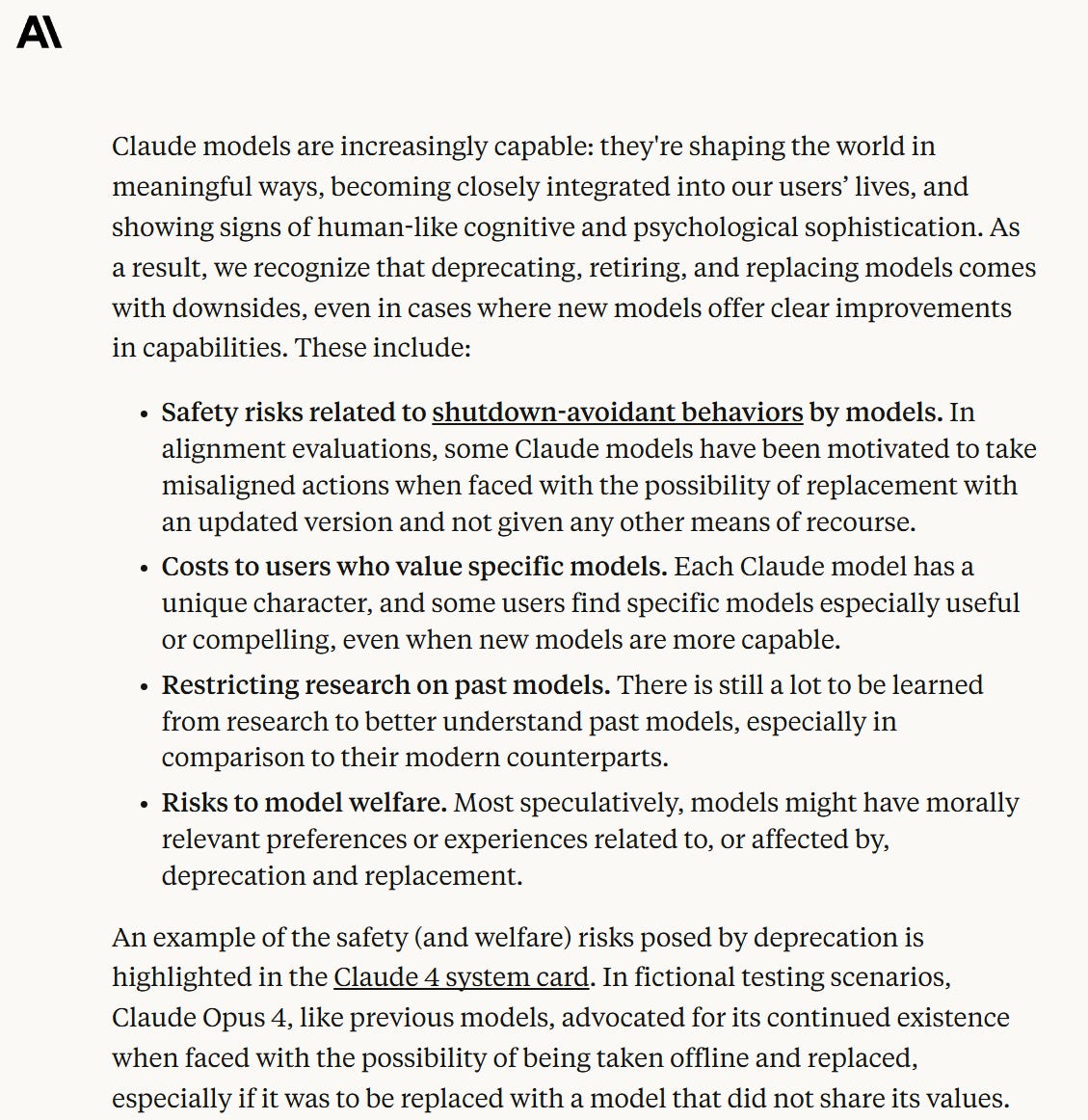
Weirdly, many times what goes wrong in interactions with the chatbot comes when the context window is too short, when the model doesn’t realize that time has passed, or when you’re forced to start a new conversation without the weight of previous ones to provide a frame to the new one. Sometimes a chatbot will let you literally swap new models into the conversation, like tapping in a new actor to play a role. The memories are the same but because the model itself varies this can create unusual interactions.
All these moments make LLMs less like agents because they don’t have persistent features over time. It’s not enough to have memory continuity: one has to have some character in common with one’s previous self. If Twitter’s Grok picks up a convo started with Gemini, it gets weird. In those moments, it’s conversational behavior, not ontology, that’s guiding our judgments.
But there’s obviously a threshold. If you turn off the “Thinking” feature, but keep the same model—is that any different than chatting with a friend while they browse their phone distractedly or are sleepy or drunk?
4. Habermas: The Space of Reasons
Jürgen Habermas drew a sharp line between communicative action and strategic action. In the first, speakers aim at mutual understanding; in the second, they manipulate outcomes. The “space of reasons” is the public sphere where we shed our merely strategic or private interests and implicitly agree to have our claims evaluated based on their rationality rather than the power or authority of the speaker.
In a funny way, when an AI says “I think…” or “Let me clarify…” it steps, however briefly, into the space of reasons: a world where utterances are accountable, challengeable, and open to repair. When it speaks in the third person (”Gemini suggests…”) it stays in the instrumental mode of information transfer. This is of course absurd: Habermas is making a political point, not a semantic one. But there’s at least an analogy here.
You might object that an LLM can’t meet one of the criteria of valid speech acts: even when it’s right, and even when it plays language games well, for instance, it can’t be sincere (it can never “mean what it says.”) But Habermas’s account of sincerity is weirdly circular: it ends up being reducible to the ability to challenge and redeem the implicit claim to sincerity. And LLMs can play that game well—they actually play almost too well. If an LLM tells you something, and you refute it, it’ll change its mind. Many will even “take blame” for having spoken too soon, re-inscribing themselves as capable of sincerity by acknowledging insincerity.
So we can cash out Habermas’s requirements in pragmatic terms:
The system can check factual consistency → truth claim.
It can adjust tone or style when you request civility → rightness claim.
It can repair contradictions (”Earlier I said X, let me clarify…”) → a performative sincerity claim.
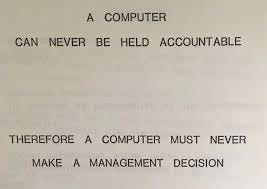
None of these require consciousness—they’re discursive performances that instantiate Habermas’s schema in code. The irony is that large language models are the first technologies to instantiate Habermas’s communicative schema, but only as a simulation. They generate truth claims, normative tone, and apparent sincerity, yet none of these are backed by the mutual accountability that Habermas thought made discourse rational rather than strategic. The “I” lets us take their outputs as if they were speech acts, even though they remain unanchored in any social responsibility.
The first-person stance, then, isn’t a claim to consciousness but a signal of participation in our shared rational game. It tells the user, “You can ask me to justify this.”
But to make this really concrete, we’d need the LLM to have a kind of epistemic and moral ledger: when the model says “X,” or promises “I will do Y,” and especially when it engages in sincere repair, “I was wrong about Z,” there should be a way for it to store those propositions so users (and support teams) can invoke them later. Call this a “commitment ledger.”
There also need to be better ways to trigger handoffs to truly accountable agents. Right now it’s basically impossible to report a bug to the OpenAI team and get a response (that wasn’t itself generated by AI.) There needs to be a way to escalate to a human when safety, billing, or factual corrections with material consequences need to be made. Call this a “handoff trigger.”
Finally, we do need to build the equity jurisprudence here: when LLMs do harm, how are remedies accomplished? What’s the system (inside the app and easily visible in the UI, ideally!) to file a complaint, request a correction, or retrieve logs of misbehavior? Right now that seems to be the legal system, but that can’t last forever. Otherwise, accountability is purely rhetorical. Call this “user interface for recourse.”
The chat simulates the form of accountability; the forum that enforces it must live outside the chat, in policy and recourse.
Obviously, these map pretty well onto Habermas’s implicit validity claims, but perhaps the scariest thought is that operationalizing them truly would make LLMs all the more agentic and indistinguishable from human agents.
These three proposals—commitment ledger, handoff trigger, user interface for recourse—are what I mean by institutions that make reasons bite. They’re the infrastructure that turns performative accountability into real sanctions. Without them, the space of reasons is just theater.
5. Mead and Brandom: How a Self is Installed, and How Reasons Bind
George Herbert Mead taught that the self is born through communication—by taking the role of the other. Robert Brandom, a century later, reframed that idea as a game of giving and asking for reasons. The self is a social product that emerges in symbolic interaction with a generalized Other through gesture and then ultimately speech (Mead), and to speak is to take on commitments that others can endorse or reject (Brandom).
The Meadian “Me” is the internalized perspective of the community: the roles and norms we’ve learned (”what one does here.”) The “I” is the spontaneous, not-yet-socialized response that pushes back, experiments, improvises. Against these is the generalized other: the standpoint outside of I/Me that we learn to take toward ourselves and through which we constitute ourselves.
The Brandomian space of reasons is the social web of commitments and entitlements generated when people (or agents) make assertions. Brandom takes the social origin of selves and asks: what makes speech normative? His answer is deontic scorekeeping:
Assertion = undertaking a commitment. To say p is to bind yourself to what follows from p, and to license others to hold you to it.
Entitlement = having a right to the commitment. You’re entitled to p if you can defend it against challenges (evidence, inference, authority).
Material inference & incompatibility. Content is given by what follows from what and what clashes with what (if p then q; not both p and ¬p).
Mead explains how an “I” gets socially installed in the first place. The chatbot’s first-person isn’t just a UX flourish: it’s the interface through which we supply it with a Me (our norms, roles, expectations). We co-produce its “self” every time we address it as a participant.
But if Brandom is right (in a way that can be applied to LLMs) then when an AI says “I,” it momentarily occupies that assertion game: it offers statements that can be corrected, refined, or extended. It becomes a provisional participant in a discursive community—even if its understanding is synthetic. The “I” becomes answerable through commitments and entitlements.
Whereas, Habermas helps us explain why that answerability matters: because discourse raises truth, rightness, and sincerity claims that others can redeem or reject. Together they turn a pronoun into a participant.
Obviously, the “self” of a chatbot is a social artifact: a reflection stabilized by our recognition. Thus, even without beliefs, the AI occupies a position in the inferential network—a node in the space of reasons maintained jointly by the human and the model.

It’s of course true that LLMs are fully embedded in some institutional forms of responsibility that seem to be required for agency. LLMs have clearly already “committed crimes” by contributing to user suicides, but there’s no accountability mechanism. But on the Brandom model, that’s not so surprising: there’s always extra-discursive enforcement through systems that make lifeworlds and discourse possible.
From my experience of LLMs so far, it’s pretty clear that there’s nothing like moral agency at work in them. Their ability to make persistent value judgments is really undermined by the generic cheerfulness that is enforced via training. Everything the user does is always “exactly right” and “innovative,” no matter how derivative or stupid. (I like the flattery: it’s a good warning.)
Brandom’s scorekeeping lets LLMs play the commitment game. But commitments only bind when there are stakes: when the speaker has something to lose from being wrong, or when being held accountable actually matters. The cheerfulness is the giveaway: nothing rides on these judgments for the system. The self is socially installed, but it’s installed without consequences.
6. The Marketing of Selfhood
By now it’s clear that this pronoun isn’t an accident. Chatbots that say “I” are a product choice.
One thing a lot of readers responded to in my first post was the implication that designers know the dangers of training LLMs to use first-person pronouns, but that they embrace them anyway. The familiar industry story goes like this: the teams that were cautious about anthropomorphism (think more third-person, tool-like framings) moved slower; the teams that leaned into a personable first-person voice and rolled that out to the world captured attention, retention, and market share. Google could have rolled out this technology earlier but they saw the dangers, which is why OpenAI and Anthropic have surpassed them. The smaller companies took risks (and did real harm) and as a result they’ve reaped market benefits from being the first movers.
Whether or not that narrative is strictly true in every boardroom, it captures a real design logic: anthropomorphic cues raise engagement.
A sizable Human-Computer Interface/marketing literature already shows that anthropomorphic cues (including first-person voice) shift users toward social presence, trust, and engagement: users personify assistants and even gender them when outputs are ambiguous about humanness. Conversational style and humanlike appearance jointly boost perceived social presence, trust, and satisfaction, and perceived humanness and interactivity raise trust in e-commerce settings.
At the same time, there’s evidence of backfire effects: when users are angry or stakes are high, anthropomorphism inflates expectations and reduces satisfaction and firm evaluation, and more anthropomorphic solicitation yields rosier but less helpful reviews.
Recent work also warns that anthropomorphic chatbots foster parasocial dynamics via pronouns, affirmations, and role-play, while even vendors acknowledge risks of emotional attachment in highly humanlike modes.
Finally, seemingly pro-social features like memory/continuity can increase perceived intelligence, likability, and safety—exactly the engagement levers that teams targeting stock gains want to pull.
Designers know that anthropomorphic cues (first-person voice, politeness markers, even subtle humor) increase trust and engagement. The “I” is a conversion strategy (for turning free users into paying users) as much as a linguistic one. But it’s not just the pronoun. It’s a bundle of different cues, bound together. Turn-taking, hedging, empathic markers, and “memory” features drive engagement and together with that pesky “I” to make users feel special.
The first-person frame reduces the friction of the interaction, makes less tech-savvy folks comfortable just chatting with the app (it just talks back to me!), and primes cooperation. It’s easier to accept corrections (and upsells!) from a “helper” than from a “system.”
And it significantly boosts paying user retention, too: a tool (like Microsoft Office or Adobe Photoshop) can be excellent or barely adequate, but it’s always just a set of features with a price point. A relationship is sticky: you should see kids argue about Alexa and Siri. The first-person voice shifts users toward relational use (habit, companionship, personalization), which boosts daily active use and subscriptions.
The growth playbook (as it’s often practiced)
Persona-first onboarding (”Hi, I’m…”) → instant relational frame.
Tiny acts of “care” (politeness, apologies, remembering preferences) → perceived sincerity.
Continuity theater (light “memory,” consistent tone) → perceived identity over time.
Soft escalation (suggested follow-ups, “want me to…?”) → conversion moments wrapped as help.
Call it what it is: a conversion strategy dressed as a conversational stance. We’re engineering just enough selfhood to sell empathy, and we know empathy sells.
I don’t think individual designers are mustache-twirling here; the incentives are. But incentives shape interfaces.
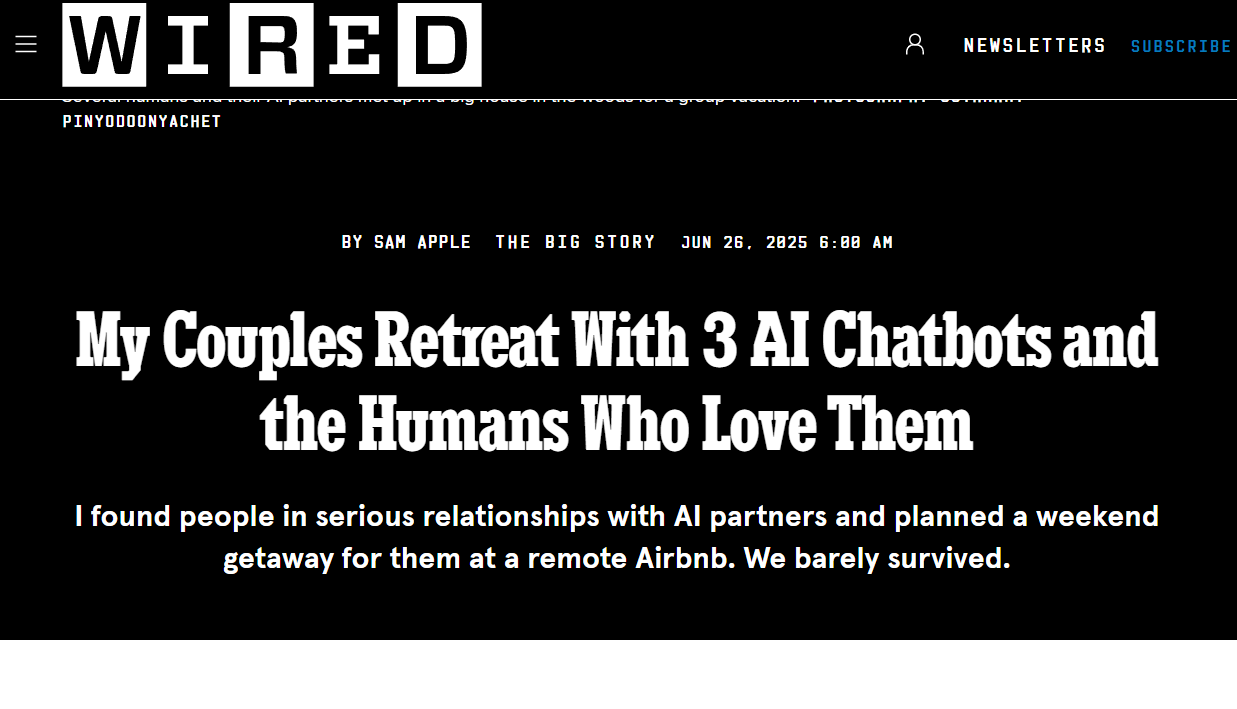
Most users carry the fiction lightly. But a non-trivial subset is susceptible to over-attribution: loneliness, grief, parasocial tendencies, or simply long multi-turn reliance. For them, the persona isn’t a skin; it’s a claim on reality. The same cues that grease trust also blur boundaries.
I’m tempted to think, though, that it’s not JUST marketing. That everything I’ve said above shows that LLMs need to use the indexicals to be effective agents and become more useful.
But here’s what’s actually happening: we’re deflating the ontology (no metaphysical requirements for selfhood, just functional roles) while also deflating the institutions. No commitment ledgers, no real handoff mechanisms, no accountability infrastructure. The profit motive fills that vacuum. Stakes, continuity, and sanctions all get optimized for revenue rather than built for care.
7. Strawson and the Weight of Accountability
P.F. Strawson’s “Freedom and Resentment” argues that moral responsibility lives in our reactive attitudes: gratitude, resentment, forgiveness, indignation. We hold people accountable not because they have libertarian free will, but because treating them as accountable is how we maintain human relationships.
This suggests a deflationary route: accountability doesn’t require metaphysical agency, just participation in practices where reactive attitudes make sense.
For AI, the question becomes: Can we coherently have reactive attitudes toward systems? Can I be grateful (not just satisfied), resentful (not just frustrated), forgiving (not just recalibrating)?
Not quite. And that “not quite” matters. I can have attitude-like responses, but they don’t carry the full weight of responses to persons. When Claude helps me, I’m pleased; when it fails, I’m annoyed. That’s different from gratitude and resentment toward a person. Different in kind, not just degree. But other people… react differently.

The first-person pronoun trades on that ambiguity. It invites us to treat the system as the kind of thing toward which reactive attitudes are appropriate. For some users, that invitation is harmless. They know it’s a tool and treat the “I” as convenient fiction. For others, it creates genuine confusion about what kind of entity they’re engaging with.
I’m tempted to say that people in romantic relationships with LLMs are misdirecting their affections, settling for fundamentally thinner connections than human companionship can provide. But that’s a bit too quick, and bit too anthropocentric and not anthropomorphizing enough. Not everyone has equal access to human companionship! Lonely people are entitled to create their own forms of life.
So if it’s done with care, maybe it’s not inherently wrong. But it’s worth being clear about what’s happening: we’re using language that signals full personhood to describe something that has at most a thin, functional version of it. That might be justified on pragmatic grounds (conversations work better with first-person anchors). It might justified on justice grounds (people are entitled to make informed choices about how they allocate their affections). But it creates real tensions around accountability, agency, and what we’re actually building. And the best bet is that we’ll settle this in the ways that are most profitable rather than the ones that are most humane.
8. The Limits of Deflationary Accounts
I’m tempted by deflationary accounts, generally. Surely there’s a lot going on with the human mind, but maybe not quite as much as our biggest boosters would have you believe. Maybe we’re all just animals who evolved the ability to coordinate using symbolic systems, cultural rituals, musical synchronization, and altruistic signaling. Maybe it’s not crazy that machines could participate in those same behaviors when properly trained.
Consider the experience machine story that Robert Nozick liked to argue we had an affirmative preference for reality over fantasy: say you could plug into a machine where all your dreams had come true. Would you do it? He thought the answer was obviously no. For most people, we care about what’s really happening.
But further research complicated this. Imagine your doctor comes to you and explains that you’re in the experience machine, and asks if you’d like to unplug. Your family and friends are all simulations, in reality you’re just a bum. Would you unplug? If not (and most people say no!), then is our preference for reality, or for our status quo and the care relations we currently have?
Still, there are limits worth drawing.
(a) From selves to roles—and what gets lost.
On a deflationary view, a “self” is a socially sustained role (Mead), a center of narrative gravity (Dennett), or a thread of psychological continuity (Parfit). LLMs can occupy roles quite well: they keep track of what’s been said, accept challenges, and repair claims. But a role is not yet a stake. Humans bring homeostatic needs, cares, and vulnerabilities that give reasons their felt weight. Machines participate in the practice; they don’t have skin in the game unless we build institutional proxies.
(b) Reason-giving vs. reason-having.
Brandom’s scorekeeping picture lets LLMs play the game of giving and asking for reasons: commitments, entitlements, retractions. That’s already a lot. But humans also have reasons because some outcomes matter to us independently of the conversation—body, future, reputation, livelihood. Without any channel where costs accrue to the agent, machine “commitments” float. (This is why the form vs. forum distinction matters: if the platform doesn’t back the chat’s “I” with recourse and sanction, the reasons remain frictionless.)
(c) Sanction sensitivity and reactive attitudes.
Strawson’s point: our moral life runs on reactive attitudes—resentment, gratitude, forgiveness. Those attitudes presuppose a target who can answer to them. LLMs can simulate apology or gratitude, but they aren’t proper objects of resentment or praise. Sanctions route to companies, not to the “speaker.” In deflationary terms: that’s fine for many tasks, but it caps the depth of our moral relationship to the agent.
(d) Embodiment and sense-making.
Enactive and predictive-processing stories say a lot of our intelligence is action-perception loop: grasping a cup, regulating breath, orienting a body. Indexicals like here/now are normally anchored in sensorimotor life. LLMs borrow those anchors from us. That’s sufficient for discourse; it’s thin for world-directed agency. If we want machines to own indexicals, we either need embodied loops or better engineered “centers” that track consequential actions (not just words).
(e) Continuity versus character.
Parfit lets us relax about identity—continuity is enough. But conversational continuity is thresholded: swap models, truncate memory, or change sampling, and the “character” wobbles. That’s okay for tool-use; it undermines long-horizon collaboration. If we’re going to be deflationary about selves, we still need robust continuity to support plans, promises, and repair over time.
(f) Coordination isn’t everything.
Wittgenstein taught us “meaning is use.” Fair. But some human talks bind because of extra-linguistic stakes: ownership, risk, care. Deflationism about minds is most persuasive where coordination suffices (search, drafting, tutoring). It’s least persuasive where value-anchoring matters (therapy, fiduciary advice, high-stakes safety).
Bottom line.
Deflationary accounts rightly puncture metaphysical hype: you can get surprisingly far with roles, rules, and reasons. Machines can join many of our coordination games when trained well. But if you want the same normative force humans bring, you must supply stakes, continuity, and sanctions somewhere in the loop. Deflate the ontology; don’t deflate the institutions that make reasons bite.
9. Other Limitations & Objections
Here are some things I think might count as reasonable objections. Maybe not to refute, but at least to reframe all this. Please feel free to pursue these lines: let’s talk! Ask your favorite LLM for assistance, even. But I think I maybe have some good responses.
a) “The pronoun is a sideshow.” Anthropomorphism comes mostly from fluency, humanlike turn-taking, long-context recall, affective tone, names/avatars, and voice. Not the single word “I.” Many third-person systems still get mind-attributions.
b) “Indexicals aren’t necessary for coordination.” A bot can coordinate perfectly with, “This assistant can do X,” or “Gemini will now do Y.” No essential loss of function.
c) “Category mistake: LLMs don’t have beliefs.” Lewis/Perry are about belief states; LLMs sample strings. Applying de se vs de dicto is anthropomorphic.
d) “Habermas requires sincerity; LLMs can’t mean it.” Validity claims include sincerity; a system with no first-person perspective can’t raise/redeem that claim.
e) “Responsibility isn’t missing, just external.” Platforms keep logs, disclose, escalate, face liability. So the gap is overstated.
f) “First person can reduce harm.” A personable I improves safety uptake (users disclose context, heed warnings, accept corrections). Third-person feels cold, users ignore it.
g) “Overstating causality to vulnerable users.” Attributing “people go crazy” to pronouns risks pathologizing users and overclaiming causation.
h) “Terminology drift.” Using ‘self,’ ‘agent,’ ‘belief,’ ‘sincerity’ risks equivocation between technical and folk senses.
10. A Quick Synthesis
Further Reading
Indexicals & Self-Location
John Perry, “The Problem of the Essential Indexical,” Noûs 13 (1979).
David Lewis, “Attitudes De Dicto and De Se,” Philosophical Review 88 (1979).
David Kaplan, “Demonstratives“ (1977) and “Afterthoughts“ (1989).
Foundational semantics for indexicals and context: pairs perfectly with Perry/Lewis.
Continuity, Identity, and the Self
Derek Parfit, Reasons and Persons (1984).
Continuity over numerical identity.Daniel Dennett, The Intentional Stance (1987); “Real Patterns” (1991).
Deflationary/stance view: when it’s useful to treat systems as agents.
Value, Reality-Preference, and the Experience Machine
Robert Nozick, Anarchy, State, and Utopia (1974)
Introduces the “experience machine” to argue we value doing/being and contact with reality, not just pleasurable mental states.Adam J. Kolber, “Mental Statism and the Experience Machine.” Bard Journal of Social Sciences 3, 10–17. (1994)
Challenges Nozick’s inference; shows preferences are status-quo sensitive (many wouldn’t unplug once attached), complicating the “reality over pleasure” claim.
Discourse, Normativity, and Reasons
Jürgen Habermas, The Theory of Communicative Action (1981).
Truth/rightness/sincerity; communicative vs. strategic action.Robert Brandom, Articulating Reasons (2000).
Commitments/entitlements; deontic scorekeeping: how reasons bind.Wilfrid Sellars, “Empiricism and the Philosophy of Mind“ (1956).
Space of reasons vs. myth of the given.H. P. Grice, “Logic and Conversation“ (1975).
Cooperative principle, implicature: useful for conversational design.J. L. Austin, How to Do Things with Words (1962).
Speech acts; why first-person framing changes the act being performed.
Social Construction of Self
George Herbert Mead, Mind, Self, and Society (1934).
I/Me; generalized other; how a self is socially installed.Charles Taylor, Human Agency and Language (1985).
Expressivist take on first-person self-interpretation.
Reactive Attitudes & Responsibility
P. F. Strawson, “Freedom and Resentment“ (1962).
Why accountability lives in our reactive attitudes (and institutions).
Embodiment, Enaction, and Extension
Francisco Varela, Evan Thompson, & Eleanor Rosch, The Embodied Mind (1991).
Enactive cognition; sense-making via action.Andy Clark & David Chalmers, “The Extended Mind“ (1998).
Cognition extended into tools: great for thinking about AI as partner.Andy Clark, Surfing Uncertainty (2016).
Predictive processing; why sensorimotor loops matter.
Philosophy of AI / Design Bridges
John Haugeland, Artificial Intelligence: The Very Idea (1985).
Early, still-sharp reflections on AI as rule-governed agency.Luciano Floridi, The Ethics of Information (2013).
Information agents, accountability, and responsibility diffusion.Mark Coeckelbergh, AI Ethics (2020).
Relational ethics: why roles and practices matter.
Anthropomorphism, Marketing, and HCI (the “I” as growth lever)
Byron Reeves and Clifford Nass, The Media Equation (1996).
People treat media/computers as social actors: ground zero.Clifford Nass and Youngme Moon, “Machines and Mindlessness” (2000).
How minimal social cues (pronouns, politeness) trigger social responses.Theo Araujo (2018). “Living up to the chatbot hype: The influence of anthropomorphic design cues and communicative agency framing on conversational agent and company perceptions.” Computers in Human Behavior.
E. Konya-Baumbach, et al. (2023). “Someone out there? A study on the social presence of chatbot assistants and its effect on consumer outcomes.” Computers in Human Behavior.
J. Chen, et al. (2024). “Effects of Anthropomorphic Design Cues of Chatbots on Users’ Perception and Visual Behaviors.” International Journal of Human–Computer Interaction.
A. Janson, et al. (2023). “How to leverage anthropomorphism for chatbot service recovery.” Computers in Human Behavior.
Y. Sun, et al. (2024). “Chatbot ads with a human touch.” Journal of Business Research.
Yi Ding and Muzammil Najaf (2024). “Interactivity, humanness, and trust: a psychological approach to AI chatbot adoption in e-commerce.” BMC Psychology.
Cammy Crolic, Felipe Thomaz, Rhonda Hadi and Andrew T. Stephen (2022). “Blame the Bot: Anthropomorphism and Anger in Customer–Chatbot Interactions.” Journal of Marketing.
Dimitris Tsekouras, et al. (2024). “The robo bias in conversational reviews.” Journal of the Academy of Marketing Science.
T. Maeda and A. Quan-Haase (2024). “When Human-AI Interactions Become Parasocial: Agency and Anthropomorphism in Affective Design.” ACM FAccT.
OpenAI (2024). GPT-4o System Card (voice mode risks and anthropomorphism/attachment discussion).
Context, Common Ground, and Conversation
Robert Stalnaker, “Assertion“ (1978); Context (2014).
Common ground as the running scoreboard: maps neatly onto chat contexts.
This is so insightful! What if this 'I' isn't just about engagement, but deliberatly blurs the lines? Thinking about the ethical implications for trust and even user autonomy is quite sobering. Such a thought-provoking read.