
They Saw a Takeover
Who gets to appear in public without being treated as a threat?

(This was written as Council considered both an emergency extension and a permanent curfew bill.)
Dan Kahan and his coauthors ran a famous experiment back in 2012. They showed people the same protest footage, but changed the supposed cause behind it. Depending on what viewers were told, and depending on their own priors, the very same conduct could read as protected political dissent or as menace, obstruction, and disorder. The lesson was not that facts do not matter. It was that facts rarely arrive unframed. People do not simply see what happened. They see what they think is happening. They see a protest. Or they see a threat.
DC is having its own version of that argument now over the youth curfew and the so-called teen takeovers. One person sees superpredators, feral kids, a city under siege. Another sees bored teenagers with nowhere to go. I think I see something more political than either of those descriptions fully captures: young people getting off their screens, gathering in public, and refusing the quiet age segregation of urban life. The same scene appears in radically different moral colors depending on what you think the underlying issue is. Is the problem youth crime? Youth exclusion? Failed parenting? A city built for adult consumption but not for adolescent presence? Once you answer that question, the crowd starts to look self-evident.
The curfew fight is about interpretation. The city is treating unsupervised youth presence in certain commercial areas as a public-order problem in advance. The teenagers, or at least many of them, experience those same spaces as some of the only places left where they can actually be together. The adult city calls this chaos. The kids may call it hanging out, claiming space, or just not disappearing on command. Those are descriptions of the same reality, reported through different vocabularies.
Panic becomes self-confirming quickly. If you begin with the premise that teenagers in groups are inherently suspicious, then every video of noise, shoving, running, or scattering from police becomes proof that the category was right all along. If you begin with the premise that the city has systematically failed to make room for youth, the same videos look different. They look like the predictable result of exclusion, boredom, overpolicing, and the steady message that young people are welcome in public only when supervised, spending money, or moving along.
The gatherings are not imaginary, harmless, or misunderstood in every case. Some of them are chaotic. Some are frightening. Some participants are plainly there for thrills, conflict, or opportunism. It would be childish to deny that. But disorder does not settle the interpretive question. A crowd can be unruly and still be socially meaningful. It can be annoying, risky, and half-articulate and still express a real grievance about who gets to occupy the city and on what terms.
The empirical case for curfews as public-safety tools is much weaker than supporters typically concede. Jennifer Doleac and Jillian Carr studied DC’s earlier shift of the general curfew from midnight to 11 p.m. and found that gun violence rose during the newly-curfewed hour rather than falling. The mechanism they propose doubles up: curfews thin out the streets and remove the bystanders whose presence normally deters street violence, while also diverting police attention from violence prevention toward curfew enforcement. Broader reviews do not rescue the policy. The Campbell Collaboration’s 2016 systematic review of a dozen quantitative evaluations concluded that the pattern of evidence suggests juvenile curfews are ineffective at reducing crime and victimization, with a slight positive effect on crime during the curfew hours themselves. OJJDP’s 2024 literature review describes the research as mixed and thin for the newer laws, and notes long-running concerns about disparate enforcement. The zone model is newer and narrower, and the Doleac and Carr mechanism may or may not transfer cleanly to it. You can argue either way. If a citywide curfew predicated on clearing streets failed to reduce violence at the level studied, though, the default assumption should not be that clearing streets more aggressively in smaller geographic bites will succeed where the broader version did not.
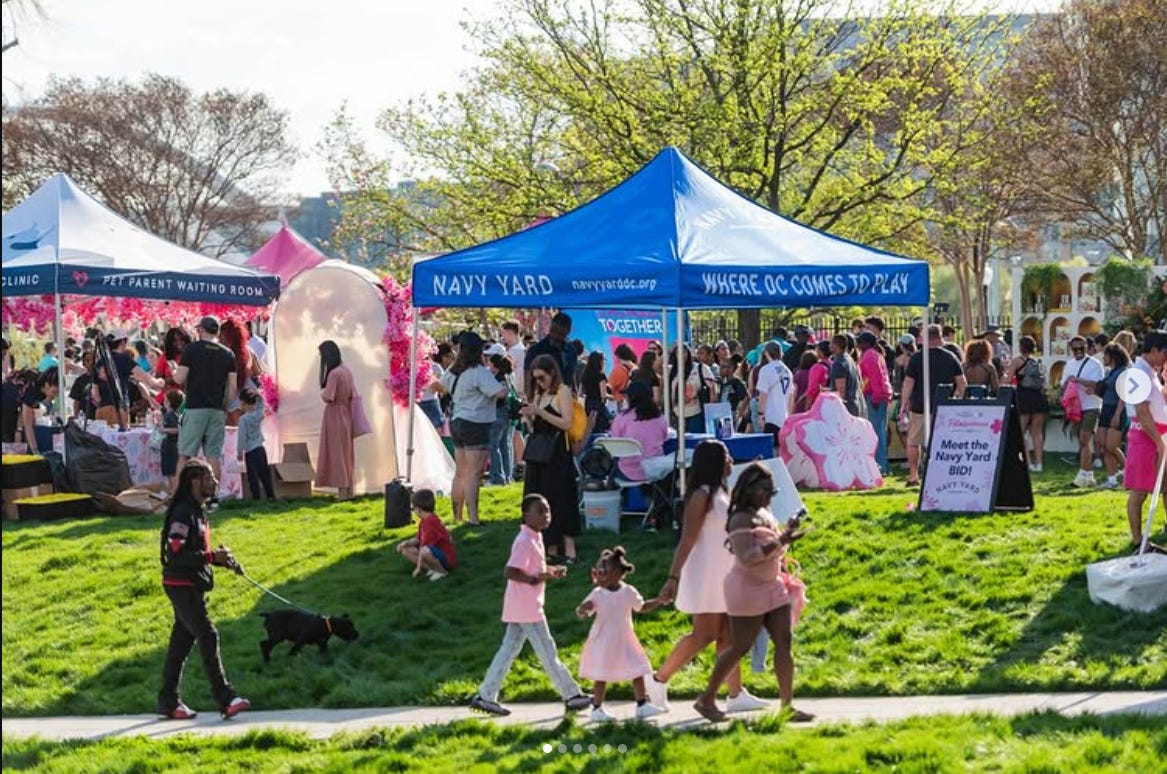
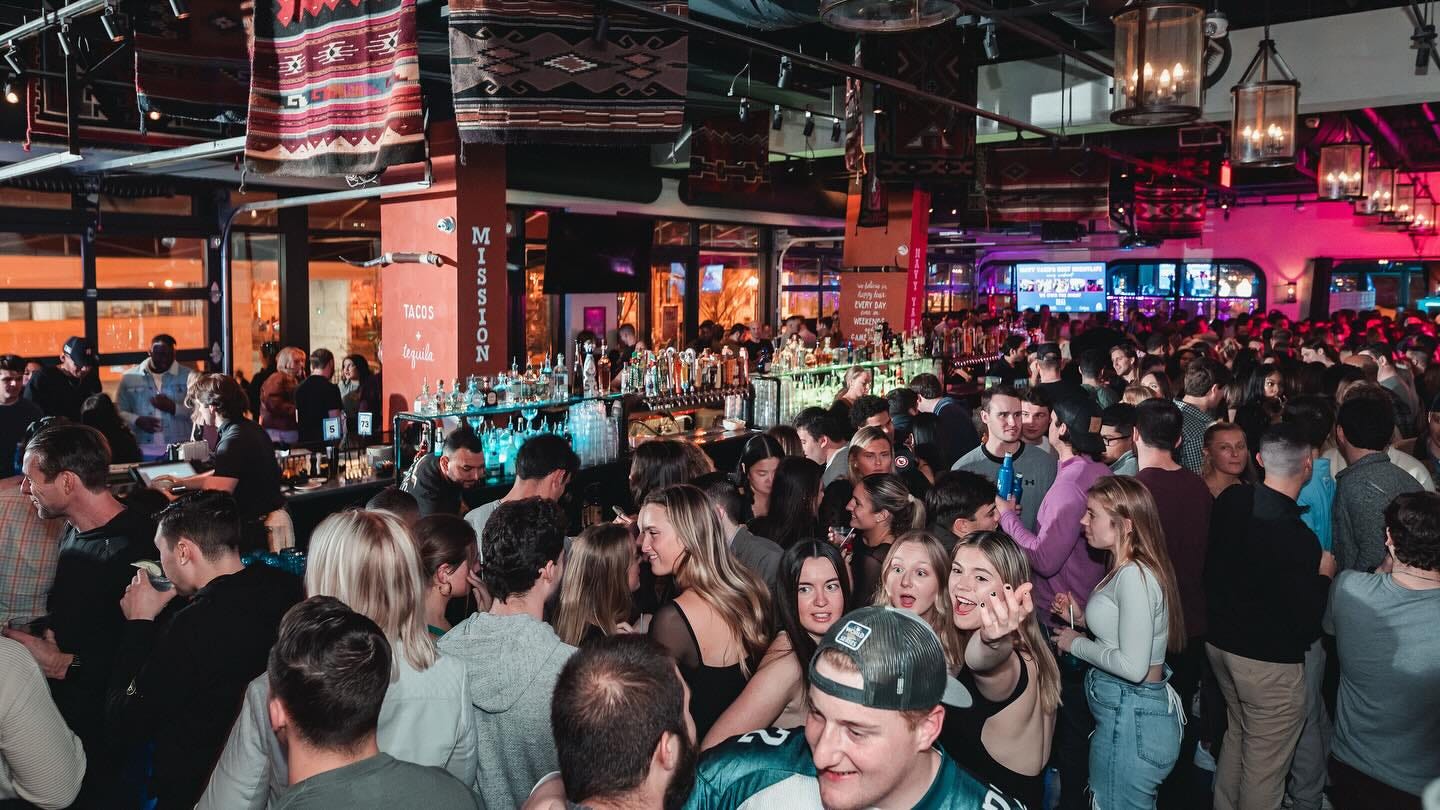
I was helped here by a Facebook post from Aristotle Theresa about Navy Yard, because it supplies the material explanation too many adults want to skip. This is not only a story about behavior. It is a story about design. Theresa writes that kids “occupy the only spaces available to them” because the city has built neighborhoods full of bars, restaurants, and adult gyms while providing very little actual youth infrastructure. Adults keep reacting to the presence of teenagers as though it were an alien invasion into a naturally adult landscape. But the landscape is not natural. It was planned, financed, permitted, and designed around adult tastes and adult spending. Then families were folded into it, and their children were given very little in return.
The frame makes the crisis look less like a spontaneous youth failure and more like the predictable result of city policy. You build a commercial district for affluent adults, provide few places where teenagers can gather freely, saturate the area with signals about who belongs and who is merely tolerated, and then profess shock when young people show up together in the spaces that remain open to them. Adults experience this as an intrusion. Kids experience it as one of the few forms of collective life still available.
Businesses, residents, and other young people in these neighborhoods have real interests in some form of immediate stabilization at specific flashpoints while deeper fixes are worked out. Supporters will answer that zone curfews are narrower than the citywide curfews most studies examine, and that the rationale extends to protecting young people themselves at recurring flashpoints. Conceding all of that leaves the curfew objection untouched. The honest debate is about which tools, for how long, under what guardrails, and paired with what investment, rather than about whether any intervention is permissible at all.
One distinction in that honest debate is the one today’s Council vote forces into view. A temporary emergency measure and a permanent standing authority are different policy objects, even when they share operative language. Someone can believe a narrow, time-limited intervention is occasionally justified at a genuine flashpoint and still oppose converting that emergency logic into a permanent authority over youth presence. Today’s Council package does both at once: a separate 90-day emergency extension and a permanent bill that would normalize the same architecture for the future. The two votes deserve different answers from a council that takes the distinction seriously.
Beneath the legislative question sits a political one in an older sense. Politics before the march and the press release: a struggle over who counts, who belongs, and who gets to appear in public without being treated as a problem. Teenagers are not usually granted much legitimate public agency. They cannot vote. They have little formal power. Their preferences are constantly mediated through parents, schools, agencies, police, and adult experts. So when they make themselves visible anyway, in numbers, in commercial districts that symbolize the adult city at its most curated, their act acquires a political charge whether or not everyone present could explain it that way.
The city is not simply saying, “violence is unacceptable” or “people deserve safety.” Of course they do. It is saying something broader and uglier: that youth congregation itself is suspicious when it happens in the wrong place, at the wrong scale, and without adult supervision. Once that proposition is in place, the line between policing conduct and policing presence gets thin very quickly. It is one thing to intervene against assault, theft, or property destruction. It is another thing to create legal tools for dispersing large groups of young people because adults do not like the look or feel of unsupervised adolescence in premium space.
The old panic never really disappeared. It just changed vocabulary. We no longer get the same explicit racialized language in polite company, at least not as often. What we get instead is the managerial version: youth nuisance, unsafe conditions, quality of life, activation, disorder, crowd management. The emotional grammar is recognizable. A group of teenagers gets read as an incipient emergency. That perception predictably falls hardest on Black and poor kids, as advocates in DC warn and as the broader curfew literature would lead one to expect. Status-offense enforcement has a long record of this, and curfew zones are unlikely to break the pattern.
Age is also the wrong variable on which to cut this. If the real concern is conduct, the police have conduct-based tools and should use them. Assault is illegal. Vandalism is illegal. Discharging a firearm in public is illegal. A curfew enforces against category instead. It targets who someone is and does not require anyone to be doing anything. A racial curfew would be rejected on that ground instantly, even if the police had statistics showing the flashpoints were demographically clustered. The age version survives because we treat age as a legitimate basis for this kind of cut in a way we would not treat race. That distinction deserves more scrutiny than it usually gets, especially when the tool being authorized is standing rather than emergency.
A city can misdescribe its own failures by projecting them onto the children forced to live inside those failures. A district built to maximize adult convenience and consumer pleasure, while minimizing youth autonomy, will reliably produce conflict when young people insist on showing up anyway. Refuse to see that and every enforcement measure will feel like realism and every alternative will feel naïve. See it, and curfew starts to look less like public safety and more like a confession of planning failure backed by police power.
Adults also demand that youth political action arrive in adult-approved form. If teenagers are disengaged, atomized, and trapped on their phones, adults lament the decline of civic life. If they gather in person, noisily, in ways that are inconvenient or hard to manage, adults call the police. Many adults seem to want youth who are expressive but not disruptive, visible but not in groups, audible but never loud enough to alter the atmosphere. That is choreography.
Redescribing every takeover as a protest would be too neat, and probably false. A lot of this is just social life under bad conditions. A lot of it is kids having fun. Some of it is posturing, some of it is conflict, some of it is boredom in search of intensity. Social life under conditions of exclusion often acquires political meaning whether participants intend it or not. When a city gives young people no real place, their mere gathering becomes a referendum on the city’s arrangements. When adults respond by treating the gathering itself as the crisis, they reveal that what they really cannot tolerate is unsanctioned youth presence.
The teenagers now being curfewed spent middle school locked at home for public health. We told them to stay inside for COVID. We are telling them to stay inside for public safety. The rationales change; the instruction does not. At some point we have to admit: they are the public too.
So yes, there is a public-order question here. There is also a democratic one. Who is the city for? Who gets to be visible in it? Who is allowed to gather without immediately being translated into a security problem? And what does it say about us that one of our recurring answers to adolescent public life is to narrow the terms on which it may exist?
Kahan’s point was that people often think they are neutrally perceiving facts when they are really interpreting them through prior commitments. That is what is happening in DC now. They saw a takeover. Others saw teenagers with nowhere to go. Some of us see, dimly, a conflict over whether young people are permitted to exist in public except on adult terms.
These gatherings may not be tidy enough to flatter liberal fantasies of respectable protest. The question is whether we are willing to admit that age-segregated cities produce their own politics of presence, and then criminalize it for being unruly. Adults look at these crowds and see disorder. The kids may just see Friday night. Under the dispute over labels lies a more uncomfortable possibility: that what looks like nuisance is also, in part, a rough and inarticulate demand to be counted.