
How a Genre Gets Made
Part 2: Fan communities as cultural R&D.

Part 1 of this series argued that consumption is productive labor: that buyers make prices true, platforms metabolize wanting into infrastructure, and the consumer is one of the machines that produces value. This post extends the argument from market behavior to cultural production.
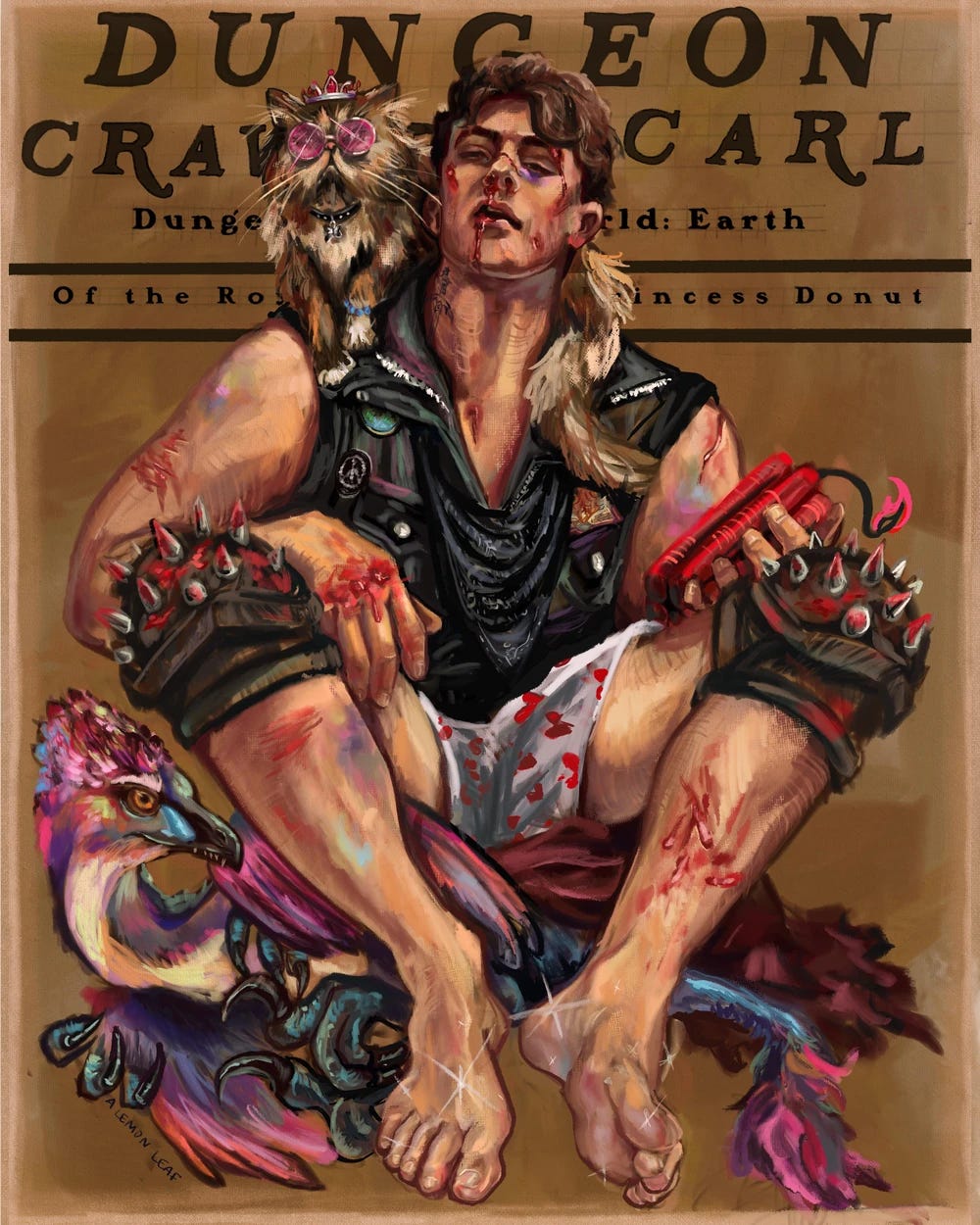
Take a silly example seriously: Dungeon Crawler Carl. The case looks like publishing gossip. It is really a theory of how taste becomes infrastructure.
Matt Dinniman started serializing what would become a LitRPG novel on Royal Road in 2020. Before that he was, by his own account, making a living selling drawings of cats at cat shows. Six years and seven books later, the series has sold millions of copies, been translated into around twenty languages, and accumulated a media footprint that includes a Peacock TV adaptation with Seth MacFarlane producing, a tabletop role-playing game that raised more than $4.5 million on its first day of crowdfunding, and an eighth book, A Parade of Horribles, that came out yesterday from Ace. (No spoilers! I’m barely a quarter of the way through!) Dinniman retained ebook rights when Ace acquired print rights in 2024, an unusual arrangement that signals leverage from a pre-existing audience rather than a publisher’s marketing plan.
But Dinniman is the visible tip of an invisible structure. The genre he was writing in didn’t come from nowhere. LitRPG drew on Russian LitRPG, Japanese light novels, isekai, progression fantasy, tabletop gaming, MMO culture, and decades of commercial tie-in fiction that respectable literary institutions mostly pretend not to see. Warhammer 40,000’s Black Library has produced thousands of novels in adjacent niche subgenres; Henry Cavill—yes, that one—has read more of them than most subscribers to the NYT Book Review have read literary fiction. “Niche” and “genre” are often just the name literary institutions give to a mass audience to which they do not personally belong. Royal Road and similar venues made the category legible at a potentially-profitable scale in English-language web fiction. They let hundreds of writers iterate on the conventions in public, with readers acting as audience, market signal, and developmental editor all at once.
What Ace bought, when it bought print rights, wasn’t just a book. It was access to a fully-formed audience that already knew how to read the conventions, plus the conventions themselves, plus the trained genre instincts of every other LitRPG writer publishers might subsequently acquire. Publishers can’t buy the conditions that make a manuscript matter, so they wait until readers have made those conditions for them, then acquire the visible part. The genre had been invented collectively, in a non-commercial gift-economy venue, by readers and writers in dialogue. Capital arrived after the fact and acquired what was already made.
The pattern isn’t unique to Dungeon Crawler Carl. Twilight fandom collectively elaborated the conventions that made Fifty Shades of Grey legible as a transposition. The obsessive, controlling-but-protective male lead became a recognizable affective contract before E. L. James turned it into a publishing phenomenon. Dramione fandom on Archive of Our Own helped elaborate enemies-to-lovers, dark-academia, and morally gray romance conventions that traditional publishing has spent the last several years acquiring and repackaging: from fanfic-to-romance pipelines like Ali Hazelwood’s to the broader dark-romance and romantasy boom. Andy Weir serialized The Martian on his website with readers catching technical errors and shaping the manuscript before Crown bought it.
In every case, fan communities didn’t just sift and surface finished work for publishers to acquire. They invented the genre. They trained the audiences who could read it. They produced the writers who could write to it. The labor of wanting wasn’t passive consumption that platforms then mined. It was active, generative, collective production of forms of life. Capital comes in after, re-packages what’s there, and sells it, with those early fans first in line.
Look at the cases that didn’t get acquired. “My Immortal” is the most famous fanfic ever written, mostly because everyone agrees it’s terrible. (You should read it. It’s an experience, but the lore is even better.) Harry Potter and the Methods of Rationality is the most famous fanfic to function as an onboarding document for an intellectual movement: nearly 700,000 words of nearly 700,000 words of Eliezer Yudkowsky laundering Bayesianism, decision theory, cognitive science, and rationalist habits of mind through Hogwarts. Its chapters directed readers toward LessWrong and the Center for Applied Rationality, and about a quarter of LessWrong’s 2013 readers reported arriving through HPMOR. Both produced entire reading subcultures around themselves. Neither got acquired by a Big Five publisher because Big Five publishers can’t acquire a reading subculture, much less a movement.
Dinniman, James, Hazelwood, Anna Todd, and Andy Weir each profited substantially as individuals once capital arrived. The communities that made the genres legible didn’t, or not exactly. They get the short-lived pleasure of seeing their niche get its moment of glory and the infinite pain of complaining about the adaptation’s weaknesses. But these gift-economy platforms function as an unpaid research and development arm for traditional publishing, surfacing apex talent that capital then acquires while leaving the supporting infrastructure of readers, taggers, beta-readers, reviewers, and convention-builders unrewarded. The genre belongs to everyone and no one, which means it’s especially available for easy enclosure. Any effort to reclaim that commons first has to reckon with this. Defending the gift economy isn’t the same as solving the systemic asymmetry between what fan-writers can do and what fan communities can.
Patreon brought back Dickens
This model should sound familiar: it’s the publishing model that gave us Dickens. Serial publication funded by subscription, paid by word count, with thousands of subscribers waiting on the next installment so millions more can read the finished product. Patreon didn’t invent serial fiction. It put the cliffhanger on a monthly autopaid subscription plan. Royal Road, Substack, Wattpad, Webtoon, Patreon, and Discord run variants of the same model. (AO3 preserves a purely noncommercial counter-model.)
Dinniman has more than 12,000 paid Patreon subscribers paying him $5 to $30 a month. They read early chapter drafts on Discord, vote in polls that decide where the story goes, and — at the top tier — pay to be written into the books as minor characters who get killed in the dungeon. One recent poll asked subscribers to choose between a setting in a suburban home with very tiny shrunken characters and a full-sized pet cat on the loose, or “Satan’s water park, with bad guys in inner tubes and mysterious liquid that may not be water.” Five thousand eight hundred people voted. Satan’s water park won. “People who vote in the poll and see it in the final product become more invested,” Dinniman told the Times, “and they tell their friends.”
By the time agents and publishers came calling, Dinniman had already sold several hundred thousand copies on his own. Ace bought print rights only (an unusual deal that let him keep digital) and the print edition has since sold more than a million hardcover copies. The science-fiction writer John Scalzi summarized it for the Times: “He banged down the commercial door and let publishers and booksellers know there was a market they hadn’t paid attention to yet.”
Pirateaba, the anonymous author of The Wandering Inn (sixteen-plus million words and counting, several times the length of The Wheel of Time), runs a similar workflow at the production end. Pirateaba writes live on YouTube while Patreon subscribers watch the Google Doc fill up. “Typo murderers” correct mistakes… in real time. Beta readers digest 40,000-word chapters in three days and send feedback that gets folded into the third-day revision. Plot points enter the story because readers in chat suggested them — the now-famous Golden Bell wasn’t in the original draft. The assistant who manages pirateaba’s schedule described the workflow as “fifty people pretending pirate is telling them a story at a campfire over Discord and YouTube chat while they write. It’s almost as if we’ve turned back time and gone back to the days when people told stories to each other.”
When pirateaba’s agent took the finished novel Gravesong to publishers, exactly one offered a deal. Traditional publishing didn’t know what to do with a web-serial author. Japan figured this out decades ago with light novels, web fiction, and anime adaptations, but the West has only just noticed the audience that’s been producing itself for years.
This is where the theoretical question becomes political. If this is labor, what form should we let recognition take? The answer depends on what kind of thing wanting is (spoiler: it’s work!), which is where two analytical traditions converge.
Two traditions for one problem
The first is Marxist and autonomist: consumption, reproduction, attention, and social cooperation are productive activities that capital appropriates from us without recognizing them as labor.
Marx already named the symmetry. In the introduction drafted in 1857 for what became the Grundrisse, he describes production producing consumption (by providing the material, by determining the mode, by creating in the consumer a need for the object) and consumption producing production (by realizing the product, by providing the motive, by producing the producer as producer). His most striking formulation is aesthetic:
An objet d’art creates a public that has artistic taste and is able to enjoy beauty.
Production produces its own consuming subject. A genre is not a shelf. It is a trained appetite. Genre does this. Platforms do this. Royal Road, AO3, and Wattpad did this.
The concept that makes the rest of the autonomist lineage tractable is Marx’s “general intellect,” developed in the Grundrisse‘s “Fragment on Machines.” Productive force, Marx argued, becomes socialized knowledge embedded in machinery, in accumulated cooperation, in cultural conventions, in the trained competences of populations. Capital appropriates this socialized knowledge but doesn’t pay for it because the wage form recognizes only individual labor inputs. The general intellect is the concept that explains why so much productive activity has always been invisible to capitalism’s own accounting. Matteo Pasquinelli has traced the phrase back through William Thompson to the 1828 London Magazine: apparently, Marx inherited the concept from a contemporaneous debate about machinery and mass education. The accounting blindspot and anxiety of influence is at least as old as the concept that names it.
Gilles Deleuze and Félix Guattari belong in this lineage too. Anti-Oedipus made the philosophical version of the autonomists’ economic argument: desire is itself productive rather than the symptom of lack, and capitalism captures desire-production through what they called “axiomatics,” the decoded flows that get reorganized into commodified output. The apparatus of capture they were describing was the family-state-factory complex, the Oedipal triangle. It doesn’t look much like the algorithmic one we have now, but the underlying point, that capitalism has correctly identified wanting as productive and is building infrastructure to capture it, is something they got right fifty years before the recommender system existed. The platform era has given their abstraction a user interface.
Mario Tronti’s “Factory and Society” extended the concept spatially: the whole of society lives as a function of the factory, and the factory walls are accounting fictions. Dallas Smythe gave it the media-economic form in 1977: broadcasters don’t sell programming to audiences, they sell audiences to advertisers. Antonio Negri and Michael Hardt later gave the affirmative version in Labor of Dionysus and Empire, framing the multitude’s productive force as exceeding capitalist measure. That exhilaration is real. I find myself closer to Federici’s strategic suspicion. Joyous productive force may exceed measure for now. What happens when capital learns to measure it anyway?
The political articulation came from Wages for Housework. Mariarosa Dalla Costa, Selma James, and Silvia Federici argued in the early 1970s that reproductive labor in the household produces labor power; capital appropriates it without paying. Federici’s pivot is what matters most for the argument we are building here. In “Wages Against Housework”she is explicit about why a wage demand was the right strategic move:
The demand for a wage makes our work visible.
The point isn’t to complete capitalism by pricing every unpriced activity. Visibility is the precondition for refusing the work. The wage demand exposes capitalism’s dependence on activities it denies are work at all. Tiziana Terranova’s 2000 essay updated the argument for the digital age: internet activity is “simultaneously voluntarily given and unwaged, enjoyed and exploited.”
I’m generalizing a bit here, skipping over important distinctions and disagreements, but still: activities we tend to treat as secondary to production (wanting, consuming, reproducing, attending, communicating) are often productive labor, and capital has been extracting value from us without recognition since before capitalism existed.
The second tradition begins from a different discomfort: maybe desire was never private in the first place. Long before Girard, moralists understood desire as comparative; Augustine on the libido dominandi, Hobbes on glory, Rousseau on amour-propre. René Girard systematized the claim in Deceit, Desire, and the Novel. Desire is triangular: subject, object, mediator. We don’t desire objects for their intrinsic properties; we desire them because others desire them. The marginalist subject-object dyad gives way to a social triangle. We learn what to want by watching wanting circulate.
Imas and Madarász, whose experimental work I cited in Part 1, formalize this and confirm it. Wanting produces value by producing position. A more recent follow-up by Imas and Graelin Mandel finds that AI involvement undermines the exclusivity premium for art: human-made artwork gained roughly 44 percent in value from being one-of-many; AI-generated artwork gained only 21 percent. The “aura” leaks out, just as Walter Benjamin predicted. The object becomes less useful for the work of comparative wanting. This is why fan communities often resist AI-generated work even when the surface output is competent. The objection is not always that the machine did it badly, though that’s often the form it comes in. (”I can tell.”) Sometimes the objection is that the machine has short-circuited the social relation that made the object valuable.
The convergence and its tensions
Both traditions reject the marginalist picture of preference as private and pre-given. Both treat wanting as social, productive, and analyzable as a form of work. The first gives us extraction. The second gives us constitution.
But they don’t fit cleanly together. The Marxist line treats the labor of wanting as something capital appropriates from a producing subject. This presupposes a subject who could in principle have done otherwise. On this view, reclamation is the recovery of an alienated capacity. The Girardian line treats desire as constitutively relational, formed in circulation rather than originating in individual subjects. If desire is always already social, there is no sovereign producer who was alienated, and “reclamation” of one’s own wanting is a category error. What you would reclaim was never yours alone.
So can we hold both at once? I think maybe. Capital really does appropriate productive activity it doesn’t compensate. The productive activity is constitutively social, not the property of isolated individuals. The political form of reclamation has to be collective and infrastructural rather than individual and proprietary.
This is why “pay me for my data” always feels too small. The extraction is real, but pricing the wrong unit can’t redress it.
The answer to the genre question, then, isn’t a wage. If wanting were private property, we could price it. But if wanting is social, comparative, and infrastructural, then the politics of reclamation can’t be individual. That becomes a question we can’t avoid once the archive becomes training data.
Part 3 picks up here. The autonomist claim had a measurement problem for as long as it existed. AI training fixes the problem… in capital’s favor.