

Bréhier's Scalpel
Deleuze, AI, and The Logic of Sense — Part 4

I’ve been promising to detail Deleuze’s logic of sense for a few posts now, and we can’t put it off any longer.
First, a confession and an indictment. Confession: as a first-year, first semester student at Bard College, I snuck into a 300-level Semiotics course taught by Fred Grab, where doctors believe I did permanent damage to my ability to think clearly about signs, signifiers, referents, and meaning by reading far too much Peirce, Saussure, Barthes, and Derrida at too young an age. (School is dangerous, kids! Do drugs!) I am thus very likely to mangle this.
Now, the indictment: the “sense” that Deleuze gives us is almost certainly a creative misreading of its sources. John Sellars, a Stoicism scholar (John, not Wilfred; but Sellars, not Searle) has carefully shown that Deleuze invented an ontology of events on a distinction that the actual Stoics didn’t really share. Something similar could be said about Deleuze’s borrowing from Husserl: he takes Husserl’s structural distinction (pretty much verbatim, modulo translation) and refuses the metaphysical grounding Husserl thought was required to make the distinction work.
Something similar is likely true of the Medieval logicians Deleuze also claims as progenitors. The resulting account of “sense” has a kind of redheaded stepchild relationship to the traditions it draws upon, and yet I’m going to try here to claim that the constructive misreading is more useful for thinking about AI prose than what either tradition, faithfully reconstructed, can give us. Husserl and the Stoics wouldn’t endorse Deleuze, but sometimes infidelity is productive.
What Husserl saw
Edmund Husserl noticed something obvious, with excruciating detail: the object I think about is not the same as the act in which I think about it (duh), and neither is the same as the meaning under which I think about it (huh?)
Husserl called this third thing the noematic Sinn—the object as intended, the meant-content of an act, irreducible to the physical object on one side and to the lived experience of thinking about it on the other. (NB: That em-dash is a middle finger to the haters, I’m bringing them back.) The noema is not a private representation in my head, and it is not the public dictionary meaning of the words I use; it is what an intentional act is about, assuming you can abstract from the act and the object alike. (It’s not X, it’s Y! ==> try doing philosophy without this.)
Where Husserl’s scheme has three positions (object, act, meant-content), Deleuze proposes four. The object becomes denotation: what the proposition refers to in a state of affairs. The act splits: manifestation names the speaker’s intentional attitudes (what I mean when I say it), while signification names the conceptual content the words carry independently of any speaker (what the words signify in the language). And the meant-content, the Sinn that Husserl was already pointing at, gets the fourth slot: sense. Husserl had identified the position that needed to be filled, but blurred it with signification; Deleuze’s claim is that the fourth position in the structure does the work that the other three cannot.
The break between Husserl and Deleuze is not on whether the slot exists but on what “sense” is supposed to be doing there. Husserl can describe the noema as the correlate of intentional consciousness, but he cannot, on Deleuze’s reading, explain how the impassive noematic content generates anything. How does meant-content, just sitting there as content, ever do any work? Husserl’s answer is to reanimate it through the constituting acts of a transcendental ego, and Deleuze calls this the problem of “immaculate conception”: sense was supposed to be productive without parents, and Husserl keeps smuggling parents back in through the subject.
Maybe Deleuze does not solve this problem in Logic of Sense either, or maybe he concludes going mad is the only solution (“We’re all mad here.” Though I like Tim Burton’s addition: “All the best people are.”) He distinguishes two sense registers: a static account of what propositions express and what states of affairs bear, and a dynamic account of how sense becomes productive at all. The Stoic framework belongs to the static register; the dynamic story is the Carroll-and-series machinery, and I am going to leave it for a later post (infinitely deferred, it sometimes seems), because I am trying to argue that the dynamic story is what is required to move from an LLM’s next-token prediction to a human’s (or true AIs’) predictive processing.
The static account can still surprise you!
Bréhier’s scalpel
When Deleuze talks about “the Stoics,” he doesn’t mean Marcus Aurelius or the latest Neo-Stoic venture capitalist bro. He means the early Stoa (Zeno, Cleanthes, and especially Chrysippus) whose work is lost and whom we know only through second-hand reports (Sextus Empiricus, Diogenes Laertius, hostile commentators like Plutarch). And, in true French form, Deleuze isn’t actually reading primary texts, he’s getting it all from Émile Bréhier’s La théorie des incorporels dans l’ancien stoïcisme. So from here on “the Stoics” means Chrysippus by way of Sextus by way of Bréhier by way of Deleuze. It’s productive infidelity all the way down.
Okay so: on Bréhier’s interpretation, the Stoics distinguished bodies (which act and are acted upon) from incorporeals… which are not themselves bodies but are predicated of bodies. According to Sellars, there are four members in Bréhier’s list of incorporeals: place, void, time, and lekta. The lekta, the “sayables,” are the contents of meaningful speech, and they exist without being thoughts in anyone’s head or sounds in the air. They’re the fourth kind of heat, if you will… which is why they come closest to what Deleuze wants to call sense.
Within this apparatus the Stoics had an account of how one body can produce an incorporeal effect in another: a scalpel cuts the flesh. The scalpel is a body. The flesh is a body. The cut, the being-cut, is not a body but an incorporeal predicate, expressed in the verb, that the proposition asserts and that the state of affairs bears. The verb does the expressing, the state of affairs does the bearing, and sense is what the proposition expresses about what the state of affairs is… doing?
That much seems to actually track what we know about Stoicism. But this is where John Sellars’s objection begins. Sellars puts the point sharply: “There is no Stoic concept of an ‘incorporeal event’ along the lines that Deleuze suggests. Nor is there any conception of parallel series of bodies–causes and incorporeal–effects inhabiting two sides of a single surface.” Deleuze takes this local grammar of cause-and-incorporeal-predicate and constructs a full ontology around it: bodies and their effects become two parallel series, one of bodily causes and one of incorporeal events, with sense circulating on the surface between them, and the two orders of time (chronos for bodies and their states, aion for incorporeal events) get added in. (Sellars traces this dual-track temporality to Victor Goldschmidt's 1953 reconstruction of Stoic time.) The result is the great metaphysics of the surface that Logic of Sense spends most of its energy elaborating, and it is not recognizably ancient Stoicism. The Stoics had the scalpel grammar; they did not have the Deleuzian architectonic built around it.
So the indictment: the scalpel is Stoic, the metaphysics of the surface is Deleuze’s invention. Why does Deleuze impute that invention to the ancients? Because the static account gives us something he needs. The Stoic example by itself describes a particular case; Deleuze’s expanded scheme turns it into a tool for thinking about the general relationship between propositions that express events and states of affairs that bear them.

What sense actually is, according to Deleuze
Spoilers for French philosophy from 1969!
A proposition expresses an event; a state of affairs bears the event. So far this looks like a theory of meaningful-and-correct speech. When an expression meets a bearing, sense is achieved… right? WRONG.
For Deleuze, sense is what the proposition expresses, and sense is also what is attributed to the state of affairs, but sense is not the achievement of correspondence between the two. Sense plays an underwriting role here: it makes the proposition intelligible enough to express anything at all, and intelligible enough for us to ask whether the state of affairs actually bears what is being attributed to it.
We can put this cleanly, because false propositions have sense. “Caesar crossed the Rubicon” has the same sense whether or not he did, and “the cat is on the mat” has the same sense whether the cat is on the mat, on the windowsill, or nonexistent. But do “green ideas sleep furiously”? Sense is prior to the true-false distinction; it allows a proposition to be true or false rather than meaningless.
I would like to say that LLM fabrications lack sense because no state of affairs bears their expressed events, but you can now see that’s not what Deleuze gives us. Matter of Bourguignon (the hallucinated citation) has a sense: it expresses a cognizable legal event in a cognizable legal form, and that is exactly why it could enter Lee’s brief, why the court could go looking for it, why the Snark could be hunted at all. Could a proposition without sense have done any of that work? You need a quarry for a snark hunt. Put another way: it could have existed.
The Snark I have been hunting through these posts now turns out to be a hostile witness. The fabricated citation is densely meaningful, and every time I mention or use it or touch it I just add more sense. The fabrication is mobile and actionable, and intelligibly false. The danger of the citation was never its meaninglessness. The danger is that it has sense without verification, sense floating free of any state of affairs.
But here’s the kicker: an LLM looks well-situated for sense-making. It is an exceptionally good producer of fluent propositions that express events of recognizable shapes (legal, medical, scholarly), and the expressed events have legitimate forms; they could be borne by states of affairs that exist. Much of what all those data centers are built to do is training. And that training is precisely for this: knowing what kind of event a competent proposition would express in a given domain.
Sense and nonsense
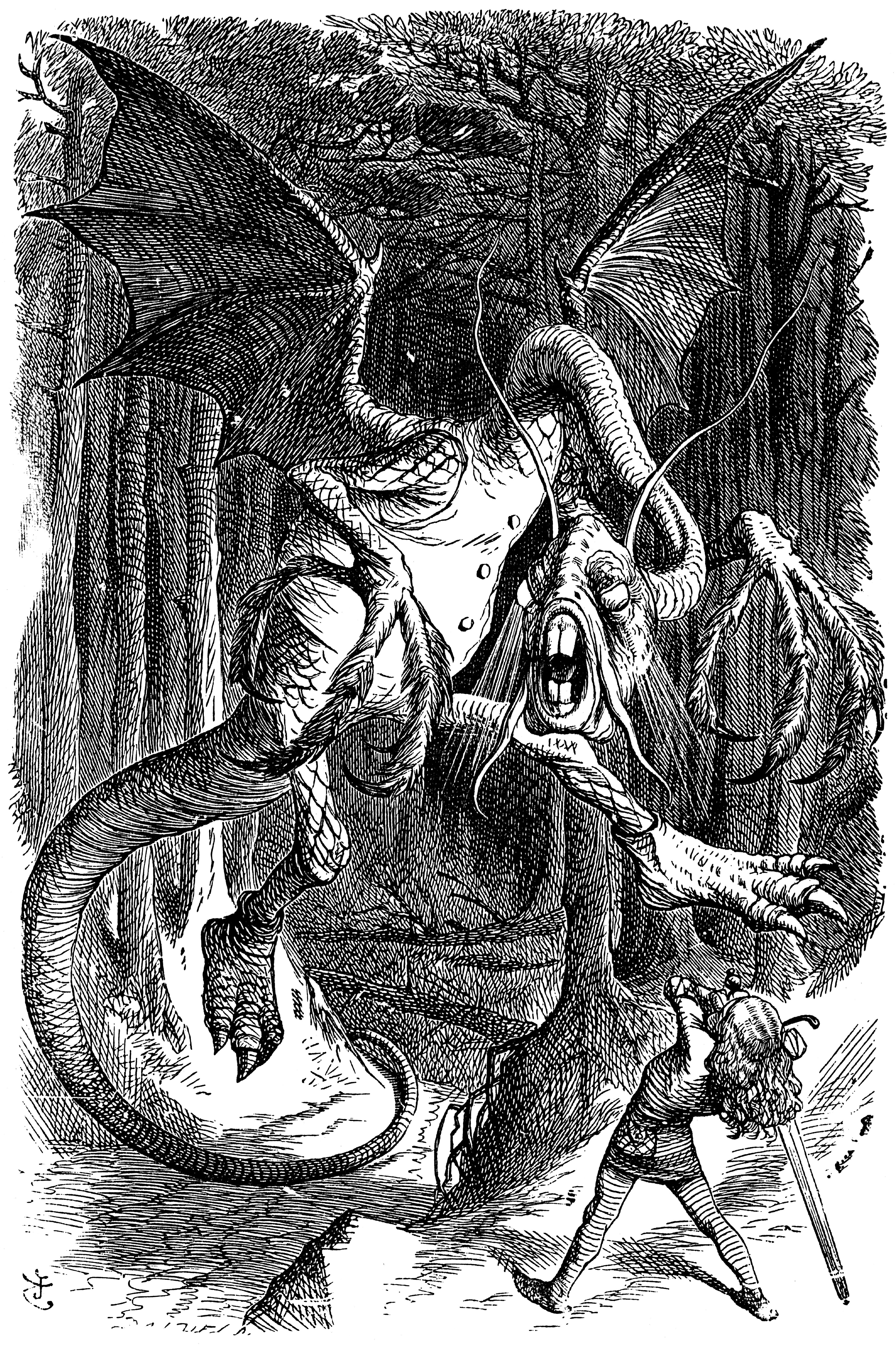
Deleuze used Carroll because Carroll could show sense being generated out of nonsense. “Slithy” is not lithe and it is not slimy; it is a portmanteau, a creature that lives at the intersection like the scalpel cut does. The Jabberwock is gyred and gimbled. We know what these mean even though no dictionary contains the words. Carroll gave us productive nonsense: combinations without resolutions that ramified across two series and produces a new surface effect that is neither.
There is also sterile nonsense (Russell’s “this circle is square”), which generates nothing because the combination cancels. The reader gets contradiction, not a portmanteau-creature. No new sense emerges.
What LLM prose does is harder. Test it: ask Claude to write you a slithy creature. You will probably get a gloss or a smoothed compromise: lithe-and-slimy as separate adjectives, an explanation, or some medium-atmospheric description that treats “slithy” as a label rather than a fused creature. Add a constraint (“write without explaining what slithy means,” or “list five slithy things, one per line, no elaboration”), and the portmanteau holds. The chatbot’s trained instinct is disambiguation: the dutiful unpacking, the helpful gloss, the polite split into component qualities. Carroll’s reflex was compression without resolution; the assistant’s reflex is its opposite. The helpful assistant’s training smooths away this roughness.
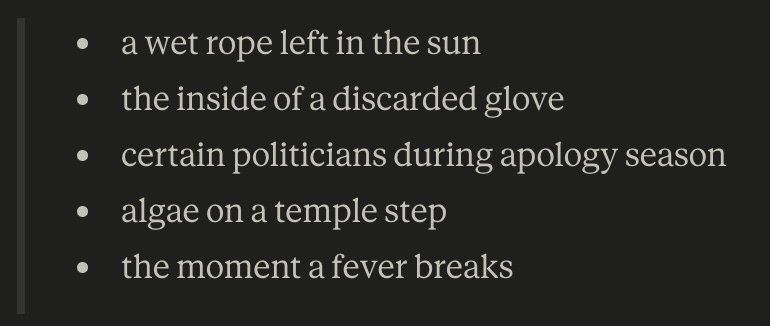
(This is what I called semantic smoothing. The model defaults to the most-probable continuation, and portmanteaus are by definition low-probability fusions that work despite being low-probability. Carroll’s nonsense is unsmoothable, while the model excretes the smoothness.)
The model isn’t sterile, though. It produces sense in abundance, more than most writers, sometimes more than I can. So what is it doing? Call it smooth sense: sense that scales by averaging rather than by ramifying. The output has the form of sense; you can read it, follow it, extract propositions from it, but the Carrollian surface-effects are missing, just like the embrace of paradox. It’s missing the sense that redounds because two pressures are being held together, like magnets resisting contact. What’s left? Something that resembles productive sense, something that passes for sense at scale but fails at proximity. It feels, sometimes, like the texture of thoughts that we’ve grown accustomed to accepting. Which is perhaps what we most fear in AI-slop: that it’s just cliché.
The portmanteau is not the only game.
Garden path sentences lead the reader down one path only to require backtracking: they require re-parsing. The old man the boat. (Wait. The old people man the boat: “man” is a verb, not an adjective.) The horse raced past the barn fell. (The horse that was raced past the barn fell.) The complex houses married and single soldiers and their families. (The complex houses, as in shelters, married and single soldiers...) You reach the right reading only by abandoning the first attempt to parse it. Nonsense turns to sense. I love this kind of thing: the experience of language reorganizing itself in real time. And isn’t this Deleuze? An element circulates between two different series, it doesn’t sit still. Garden path sentences teach the reader that sentences can be puzzles. The helpful-assistant chatbot default rarely writes them, because the helpful-assistant default aims for clarity and garden paths don’t.
I’ve discussed contronyms before, but what about things like this?
“When I use a word,” Humpty Dumpty said, in rather a scornful tone, “it means just what I choose it to mean – neither more nor less.”
“The question is,” said Alice, “whether you can make words mean so many different things.”
“The question is,” said Humpty Dumpty, “which is to be master—that’s all.”
Lewis Carroll’s em-dash usage notwithstanding, this exchange manages a meta-feat. It both describes and embodies a linguistic position about meanings at the same time. A large language model can describe this exchange, and even analyze Humpty Dumpty’s position in this one, drawing on skads of secondary sources, I’m sure. But Claude struggles to produce arguments that have this shape: arguments whose subject and whose form are the same thing, where the sentence is also an instance of what the sentence is about. (You can ask for it. You might get it, but when I asked, I got this: “The sentence describing garden paths leads readers down expects a noun phrase but delivers a verb.” I’m still not convinced that’s a truly successful garden path sentence, and you have to ask a lot to get even that, but arguably a garden path sentence is itself a genre of sentence that LLMs should be able to build.) Still, the meta-reflection is the kind of Mobius strip of sense that twists new surface effects out of the turn. The chatbot smooths it because the helpful-assistant default prefers to be about something rather than to do something.
Are these boutique literary effects, or are they are the everyday operations by which language gets sense out of nonsense, by which writers since Carroll have produced effects beyond what the dictionary offers? I think they train readers to understand that sentences are not only statements but can become events themselves. Where the computer sees an error to be corrected, Deleuze sees a surface where combination without resolution preserves and disambiguation destroys.
Smoothed prose has an unbroken surface: no portmanteaus, no garden paths, no contronyms, no language that turns back on itself and bites down despite the pain. Editors and writers have always worked at smoothing, and some are proud of it. But Carroll’s sense survives the smoothing test. A goal for writing in these times might be to become unsmoothable, unsummarizable, unflattenable.