

The Bellman's Method
Deleuze, AI, and The Logic of Sense — Part 2

What hallucinated citations, smoothed prose, and AI detectors share is a voice that borrows warrant before the work has been done.
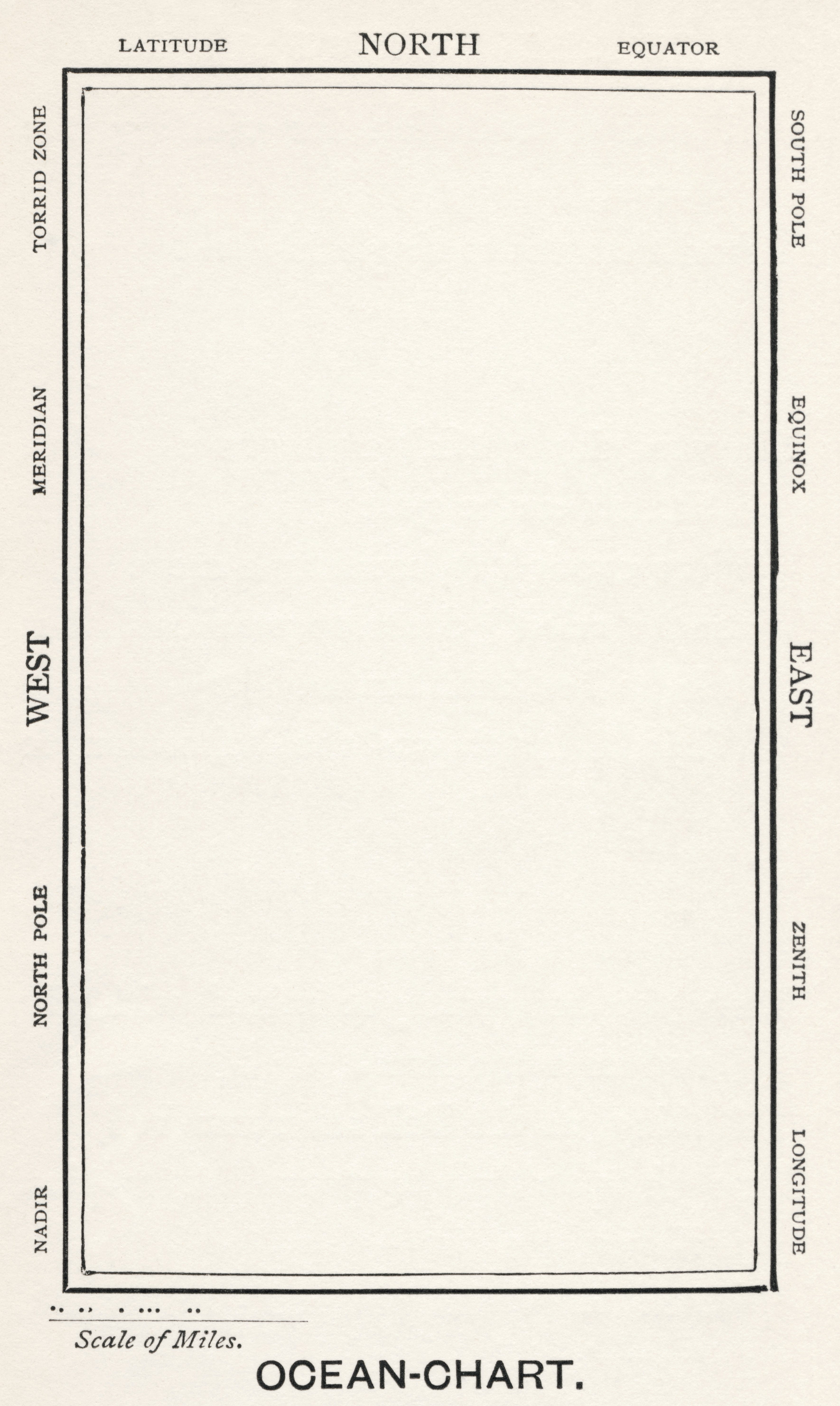
Building on Deleuze and the discussion in my last post, the Looking-Glass world has three characteristic objects: the Snark, the blank map, and the Bellman.
I’ll map these as failures of reference, content, and warrant. They do not line up neatly with Deleuze’s four dimensions of the proposition, and that mismatch is part of what’s interesting. They are better understood as three ways prose can acquire the appearance of sense without earning it.
(Today's Snark is Carroll's beast, the source of the colloquial "snide remark" that "bites and scratches"; earlier thoughts on the descended usage here.)
The Snark
A hallucinated citation has a name, a habitat, a method of pursuit, and enough institutional plumage to send you hunting. The author sounds real. The journal sounds real. The title has the right shape of academic abstraction, a nice colon specifying its subject. I’d like to suggest that a fake citation is a paradox of the same kind: a confident reference produced at the crossing of two series, the demand that an argument have a source and the learned appearance of what a source should look like. It is structured pseudo-reference.
Carroll’s poem is a parody of method. The Bellman holds the blank map. The crew of ten hunt the Snark by means of thimbles, care, forks and hope, a railway-share, smiles and soap. They know the Snark by five unmistakable marks. They are confident and competent. They are prepared. It doesn’t help.
The Snark is Deleuze’s example of how productive nonsense generates sense by failing to settle, how the paradox keeps both senses alive in itself rather than resolving into one. I like this idea of failing to settle, and that is why it works long enough to organize a hunt. (John C. Brady’s two-part 2017 essay treads similar ground exegetically.)
The Boojum is a “particular variety” of Snark, defined entirely by its effect on the hunter. Carroll never tells us what a Boojum looks like, only what happens when you find one. You learn what a Boojum is by being undone by one. The defining feature is that the hunt looks like every other Snark hunt until the moment of recognition, at which point the hunter is no longer there to report.
In the midst of the word he was trying to say,
In the midst of his laughter and glee,
He had softly and suddenly vanished away,
For the Snark was a Boojum, you see.
The hunter vanishes mid-word. Recognition and undoing in the same instant. He does not finish the sentence in which he is naming what he has found.
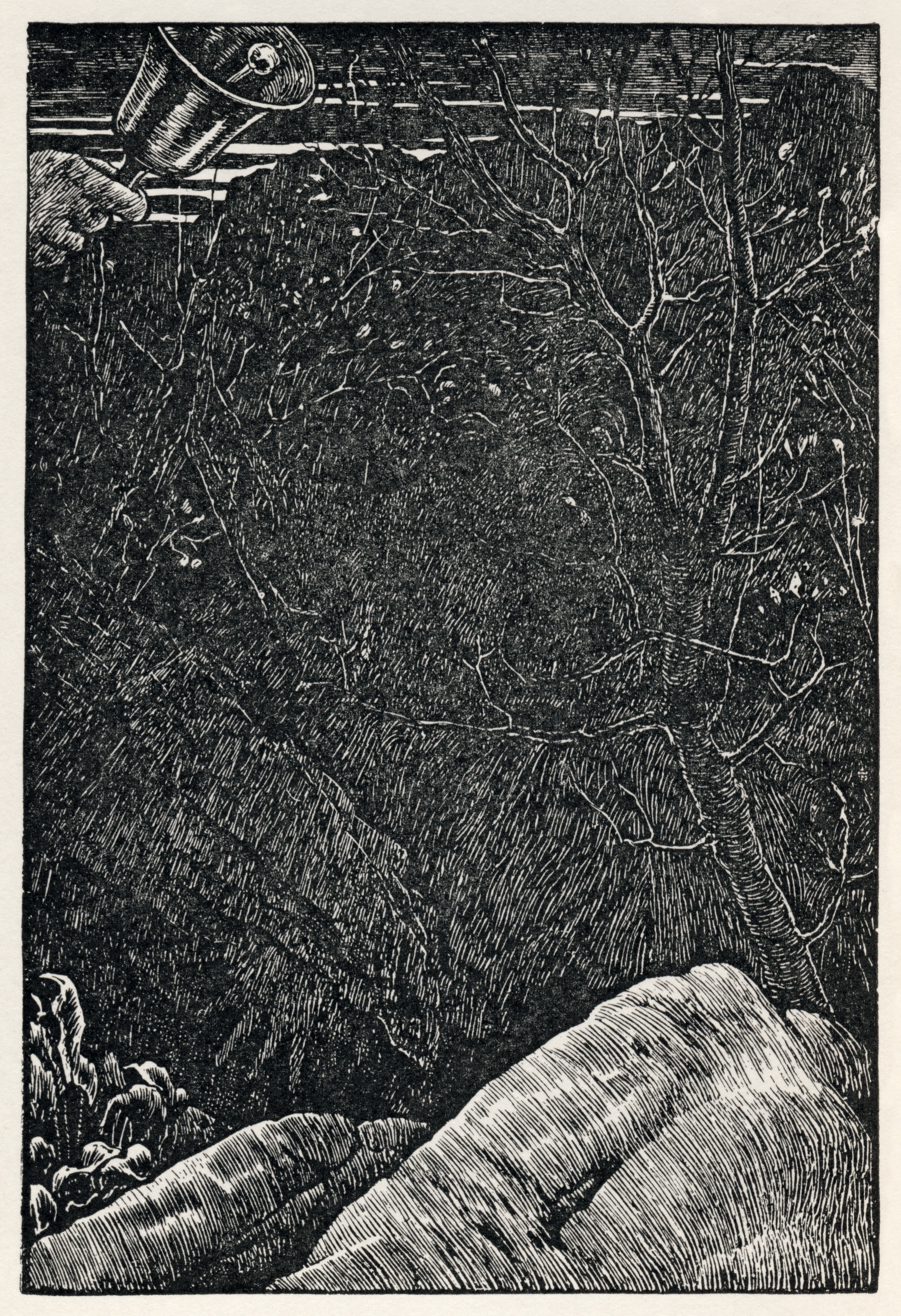
The colloquial use of “snark” operates on the same logic. We derive metaphors from concrete entities all the time: we call a sedentary person a couch potato, for instance. But Carroll’s Snark is unusual among imaginary derivations: it never appears in its own poem, only in its effects on the hunter. Calling snide commentary “snark” therefore borrows the name of a creature defined entirely by its effects, the way a child’s bogeyman is. And perhaps the borrowing stuck because conversational snark has the same deniability: hard to call out without the caller exposing themselves as humorless, paranoid, or thin-skinned. The hunt destroys the hunter.
Carroll wrote this stanza first. According to Morton Cohen’s biography, on July 18, 1874, walking near Guildford after a sleepless night caring for his dying cousin, the closing line came to him spontaneously. He wrote the rest of the poem backward over the next eighteen months. The Snark exists, in the strict compositional sense, to set up its own undoing.
On January 30, 2024, the U.S. Court of Appeals for the Second Circuit decided Park v. Kim. Attorney Jae S. Lee, representing the plaintiff-appellant on appeal from the Eastern District of New York, had cited Matter of Bourguignon v. Coordinated Behavioral Health Servs., Inc., 114 A.D.3d 947 (3d Dep’t 2014), as authority on a workers’ compensation point. The panel could not find the case. Ordered to furnish a copy, Lee filed a Response on November 29, 2023, in which she explained that she could not, because the case did not exist. She had used ChatGPT, she wrote, “for assistance in case identification.”
She names it herself, in her own Response: “this non-existent case.” Might as well just call it a boojum. The hunt had looked exactly like every other citation check until the moment Lee tried to deliver what she had found, and the act of delivery was the act of vanishing from the position she had occupied: counsel of record, citing precedent, advancing an argument.
The court found that Attorney Lee “did not read or otherwise confirm the validity of the (non-existent) decision she cited,” and held that her conduct “falls well below the basic obligations of counsel.” It referred her to the Court’s Grievance Panel and ordered her to provide a copy of the ruling to her client, translated into Korean if necessary so the client could understand it.
Lee’s case is one of more than a thousand. Damien Charlotin’s running tracker logged 1,459 worldwide as of May 2026. The model is generous with Snarks. They have a name, a year, a journal, a DOI-shaped tail; some have realistic abstracts; a few have plausible page numbers. The verification cost falls entirely on the reader. Normally, the model bears none of it. (Though I’ve developed a fact checking prompt that tries.) That asymmetry, and not the existence of the Snarks themselves, is the danger.
The blank map
The second Carrollian object is from the same poem. The Bellman has bought his crew a navigational chart:
He had bought a large map representing the sea,
Without the least vestige of land.
The crew loves it. A perfect and absolute blank! No inconvenient features. No confusing place names. No shoals or harbors. Just pure navigability.
I know it’s a stretch, but follow me here: the blank map is the AI-smoothed paragraph. I love using Claude for copy-editing, but when I asked it to “improve” my prior post on the language of intoxication, it did a lot more.
“Five hundred and forty-six words for drunk” became “many synonyms for intoxication.” The absurdly specific spelled-out number vanished, along with the citation to Christina Sanchez-Stockhammer and Peter Uhrig, the linguists who counted. But also replacing the monosyllable “drunk” derived from German for “intoxication,” a higher status Latinate term.
It cut “Logorrhea” for “verbal static.” The clinical grotesquerie was stripped clean, losing the mouth-feel of a word that rhymes a bit too well with indigestion. Claude’s substitution preserved the category and lost the embodiment. I had made a specific reference to Emily Bender and her “stochastic parrots,” a term that circulates perhaps too widely because of its fricatives, and became a generalized point about LLM limitations. The specific citation with a modulated set of claims was lost, replaced with a vague consensus. No one in particular made the point, so no one in particular can be wrong about it. Even the typo agaisnt disappeared, harmlessly enough. Of course a copy editor should fix a typo. But taken together with the other substitutions, everything idiosyncratic, attributable, or resistant was being sanded down.
Each edit preserved the map’s function. The paragraph still told you where you were in the argument. What it lost was the coastline: the specific number, the named instance, the datable occasion, the link a reader could follow. Who did what, to whom. This is a generalized problem with a lot of academic prose that tries to bluster beyond its specific knowledge.
The problem is that readers often prefer this kind of blank map. Coastlines slow people down. Predictable moves let the eye glide smoothly, too, and the humans providing feedback for reinforcement learning can be lazy, too. Semantic smoothing is optimized against friction.
The Bellman
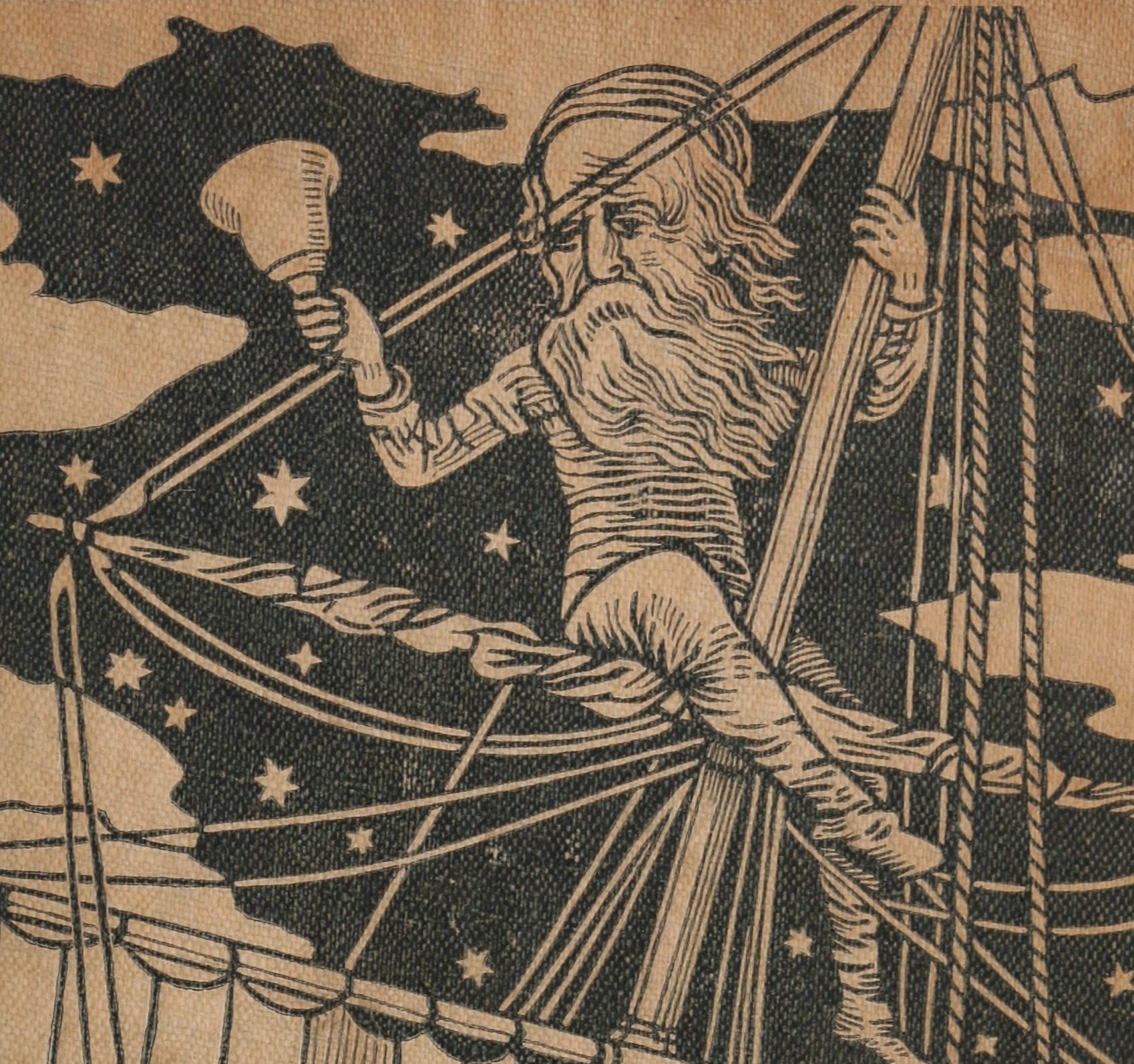
The Bellman is the captain of the Snark-hunting expedition. He is endlessly confident in his method. His first principle is repetition: “Just the place for a Snark!” he announces, “I have said it thrice: / What I tell you three times is true.” His authority is inferred from appearance: his crew can “see he was wise, the moment one looked in his face,” before discovering that his map contains no geography and his navigational orders contradict themselves. But he is unbothered:
“That’s exactly the method,” the Bellman bold
In a hasty parenthesis cried,
“That’s exactly the way I have always been told
That the capture of Snarks should be tried!”
The third object is a slightly different kind of thing from the first two, and one of the hardest to train out of LLMs. The Bellman is a category of how the model uses register and voice to provide (the illusion of) epistemic warrant: it sounds like it knows what it’s talking about. Snarks usually arrive in Bellman cadence. Blank maps almost always do.
The cadence does the work the content cannot do alone. Procedure before grounds: Step-by-step; Best practices; Research shows; Courts have held; Scholars agree. Method-talk performed in the rhythm of finished expertise. Often the research does suggest. Sometimes courts have held. Maybe the practices are best. The Bellman cadence moves through true and false material at the same polished gait. It gives epistemic momentum to claims that have not yet earned it, and it doesn’t have the decency to be ashamed of its uncertainty (because it’s not aware of it.)
The Bellman is the connective tissue of semantic smoothing. Without his voice, a Snark is just a wrong citation and a blank map is just generic prose. With his voice, they acquire epistemic camouflage: they go down easily because they sound like they have already cleared some expert’s evidentiary hurdles. The Bellman cadence is what makes the first two failure modes pass for knowledgable prose.
The Bellman’s authority-laundering is not confined to chatbots: they learned it from watching us! The Bellman shows up in the consultant summarizing quickly googled facts, the policy memo laundering a few promising pilot programs into a confident platform, the executive briefing that collapses twelve vexatious scholars into a paragraph that sounds like a slam-dunk decision. The Bellman is an institutionalizing voice: it arrives with a rhythm that conveys that “I have already done the work, the work is done, here is the result.” That voice has always been with us, but the model has industrialized it.
He also shows up, more recently, in the AI detector’s confident percentage, the forensic claim that a surface has been adjudicated. The score that says 87 percent AI-generated is a Bellman move unless we understand its training conditions. The same culture that mass-produces Snarks now sells Snark-detection, often in the same polished voice. The Bellman does not only write the answer; he also grades it.
As I discussed last week, Jamir Nazir’s “The Serpent in the Grove“ won the Caribbean regional prize at the 2026 Commonwealth Short Story Prize. Pangram flagged the story at 100 percent AI-generated, high confidence. The extra-textual pattern now seems firmer: the submitted headshot itself appears to beAI-generated, the author’s online footprint reads like the LinkedIn-spam fingerprint we have all come to recognize, and Nazir has not piped up to defend himself. Three other Commonwealth Foundation prize-winning stories have since been flagged.
In an earlier post I ran a different experiment. I gave GPT-5 the opening 500 words and asked it, blind, to continue in the same voice. The continuation reproduced several of the story’s beats: personified setting, the air sweet with cane, a three-drink escalation, a mysterious-origin frame for Zoongie. The words differed; the moves were nearly identical.
That made me more suspicious. It can’t tell me who wrote the story. The Pangram flag, my experiment, and the extra-textual pattern together amount to a damning circumstantial case, but that’s not the same as an indictment. The temptation to convert suspicion into guilt is itself a Bellman temptation: the promise that a method has carried us farther than it actually has. The Bellman cannot resist saying “100% AI” when the available evidence only licenses “take a closer look.” Neither, often, can we.
Three counterfeits of sense
These three failures do not exhaust the four dimensions Deleuze names in Logic of Sense. They are three ways LLM prose can counterfeit the appearance of sense: a reference that isn’t there, content stripped of resisting particularity, warrant unbacked by work. Whether sense (Deleuze’s fourth dimension proper) is a different thing from these or just a name for what’s left over when all three are fixed is a question for future posts.
I am convinced that AI can be trained not to make these specific mistakes. LLMs can run processes that check their citations and balance their claims with evidence ledgers. They can be prompted to get more specific about causality, to respond honestly when they don’t have a way to tell whether the answer that comes to mind is correct. They can certainly be encouraged not to be overconfident or adopt speech patterns that encourage certitude.
But if we fixed those things, would the result be sense? Is the feeling that nothing is behind the prose just an accumulation of the surface failures? Is it a kind of semantic uncanny valley? Or worse: is “sense” itself a distinct fourth thing, or just propositional content that Deleuze’s overly narrow account of ‘signification’ had to leave out?
If the answer is yes, then there’d be nothing extra to diagnose: “sense” would be metaphysical assertion dressed up as phenomenology and linguistics. A perfectly self-checking, citation-balanced, hedge-honest, register-sober LLM would produce prose that reads as meaningful, lands accurately, and tracks the world. The reader’s reports of emptiness might persist, but they’d be themselves hallucinations or simple motivated reasoning.
I’m writing now as if the answer is no, but I’m not certain. What I am convinced of is that there are more wrong answers circulating to deplore AI than there are valid objections.
The Bellman clarifies why the present models so often feel empty even when their references hold. Their characteristic vice is not only that they invent Snarks or offer blank maps. It is that they speak as though the hunt has already succeeded. They give us the tone of arrival: the confident conclusion.. That may not be the absence of sense, but it is one of the most easiest ways to counterfeit it.
Are you back to blogging?